
BY DANIEL SCHMIDT
THE OBSERVER
LEE COUNTY — The newly formed Gulf States Independent Athletic Association is expected to result in the dissolution of one of Alabama’s two athletic associations.
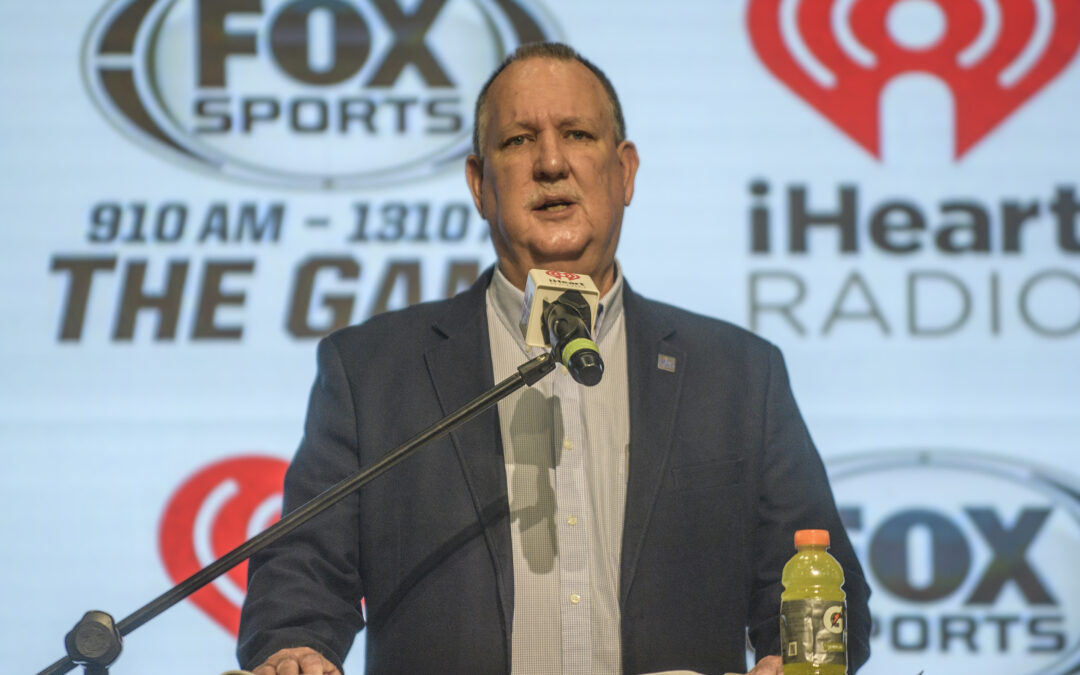
At the Fox Sports The Game High School Football Media Days in Opelika on July 29, Alabama Independent School Association athletics director Roddie Beck said he expected the new proposed association would cause the AISA to disband its athletics program.
If that indeed happens after the 2026-27 school year ends, it will end a 56-year run that began in 1970, when the AISA first offered athletic competition for its member schools.
“Obviously, if this new association moves on, this will pretty much be the last year of AISA,” Beck said. “That’s tough to talk about, tough to say.”
The formation of the GSIAA has gained momentum in recent weeks after private school officials from across the state voted to move forward with the proposed association during a meeting in Montgomery on July 24.
While an executive director has not yet been named, play is expected to begin during the 2027-28 school year and be fully implemented when the 2028-29 school year starts.
After private-school officials from across the state voted to move forward with the proposed association during a meeting in Montgomery on July 24, the GSIAA appears to be hurtling toward viability.
Roughly 150 to 175 people attended that meeting, and 89 of the 93 private schools affiliated with the AHSAA and the AISA were represented.
According to Beck, Macon SEast Academy headmaster Glynn Lott — who also heads the AISA’s coaches association — approached AISA executive director Michael McClendon and effectively asked for permission to create a new association.
Lott said the new proposed association was borne out of frustration some private school coaches had with enrollment multipliers and competitive balance enhancements last October.
Those tools were originally intended to even the field between public schools that aren’t allowed to recruit athletes to play for them and private schools that are allowed to.
Lott added that there was disagreement over the AHSAA effectively denying athletic eligibility to students who used CHOOSE Act tax credits to attend private schools. According to Lott, the AHSAA said it considered student-athletes who used such funds to be receiving financial aid, rendering them ineligible.
Then, in January, the AHSAA’s Central Board of Control voted 13-2 to overhaul its classification system, separating public and private schools into their own championship brackets for the 2026-27 and 2027-28 school years.
Those classifications — Single-A Private and Double-A Private — scrapped the enrollment multiplier and competitive balance enhancements private school coaches had complained about months earlier.
While the two new private school classifications still allow for regular-season games between private and public schools, it prohibits postseason competition between them.
However, the restructuring was the last straw for some private-school administrators, and at least one AHSAA member, Autauga Academy, almost immediately opted to return to the AISA.
“Everybody was fussing about the travel and the competitiveness,” Lott said. “I’ve been doing this for over 30 years, and when you do it every two years, or however many years, you go in a classification system, it doesn’t matter when you reclassify; there’re always going to be people upset, [usually] the people at the bottom of each group. They want to be at the top. The line should have always been a couple of more [teams] down or a couple of more [teams] up so it fits them. So there’s always people upset at traveling and all that every two years.”
With those discontentments bubbling underneath the surface, the pieces quickly fell into place due to the two associations not being as separate as they appear, according to Beck.
“A lot of people really don’t know, [but] a lot of those private schools that play in the [AHSAA] have board members on the AISA,” Beck said. “We have six or seven board members who are from private schools in the AHSAA. So everything just happened to fall in place. It moved mighty quickly.”
To address many of the root issues that drove private schools to the GSIAA in the first place, Lott said the new association will feature a member schools-led governance structure.
Bylaws changes and new rules implementation will require at least a two–thirds vote, and the inclusion and exclusion of specific teams will lead to a more balanced field of play and drastically reduced travel distances.
With preliminary GSIAA meetings now complete, Lott said the next steps are to seat a founding board, finalize bylaws and a handbook and pursue affiliate membership with the National Federation of State High School Associations.
Regarding classifications, Lott said presentations made to prospective member schools have included three divisions for traditional 11-man football teams and one division for eight-man football teams, although those plans have not yet been finalized.
There are currently no defined plans for divisions for other sports, such as volleyball, basketball, wrestling, baseball, softball and track and field.
For the AISA, the decision now has a date attached to it. Beck said its board will meet on either Sept. 16 or 23 to vote on whether to end the AISA’s athletics program.
Beck was quick to draw a line between AISA athletics and the broader organization itself, saying the organization will continue to represent private schools in other capacities.
“The AISA will still be an association. We offer government relations, accreditation and activities,” Beck said. “So, the AISA will still be here. It’s not going anywhere. It would just be that this would be the last year of AISA athletics, and the new association would pick up the following year.”
In Lee County, up to four private schools and one homeschool athletics program could be affected by the GSIAA’s creation: AISA member schools Trinity Christian School and The Oaks School, AHSAA member schools Lee-Scott Academy and Glenwood and Alabama Christian Sports Conference member program Southern Christian Athletics.
The Oaks athletic director David Shabo said that while the school is “definitely interested” in learning more about the GSIAA, administrators are evaluating the situation to determine what’s best for their student athletes moving forward.
“We’ve had some concerns about the number of teams [participating in the AISA] because it does increase travel times and makes for a competitive imbalance,” Shabo said. “Sometimes we’ve played much larger schools within AISA, and I know that’s one of the complaints that the private schools are having with the AHSAA now. But what would change our calculus is if we got some definitive answers about which schools were definitely going to join.”
[Section for Trinity here]
Within the AHSAA, Lee-Scott and Glenwood will be the two area private schools competing in Class Double-A Private this upcoming season.
Glenwood will be placed in Region 1, which includes Houston Academy, Montgomery Catholic, St. Michael Catholic, St. Paul’s Episcopal, UMS-Wright Preparatory, Faith Academy and McGill-Toolen Catholic.
Lee-Scott will be placed in Region 2, which includes American Christian Academy, John Carroll Catholic, Madison Academy, Randolph School, St. John Paul II Catholic, Westminster Christian Academy and Briarwood Christian.
According to enrollment figures released by the AHSAA in January, Lee-Scott will be the fifth-smallest school in the classification, while Glenwood will be the smallest with enrollments of 207 and 191 students, respectively.
Among the largest Double-A Private schools are McGill-Toolen (483 students), Briarwood (426 students), Faith Academy (418 students) and John Carroll (404 students).
Last season, Lee-Scott and Glenwood competed in Class 3A Region 4, which had an average one-way travel distance of 51 minutes between campuses for the Warriors and an hour and six minutes for the Gators.
On average, Lee-Scott must travel two hours and 51 minutes, and Glenwood must travel three hours and five minutes each way for away games this season.
Lott said he expected the GSIAA to give member schools travel times comparable to what Lee-Scott and Glenwood experienced before the AHSAA implemented the new classification system.
“We left out the four larger schools in Mobile and one in Huntsville because I don’t know the answer to those. They’re so big,” Hall said. “But if you do that, the competitive factor gets really close to being even, and the average travel distance I think was 61 miles one way inside your region.”
Neither school responded to a request for comment before Tuesday’s press deadline.
That noncommittal approach did not apply to every prospective program that could join the conference.
Jason Scott, Southern Christian’s athletic director and head football coach, said his program currently has no intention of joining the GSIAA.
“At this time, Southern Christian is happy competing in the Alabama Christian Sports Conference. We have no plans on leaving the ACSC,” Scott said. “We are, however, grateful to the AISA for their partnership, and hopefully the new conference will be as accepting of our conference partnering with them as they have in the past. Mr. Beck has done an amazing job making the AISA a very competitive organization, and we look forward to seeing how the new organization and framework will deliver top-level sports competition to the schools and teams they represent.”
