
BY MICHELLE KEY | PUBLISHER
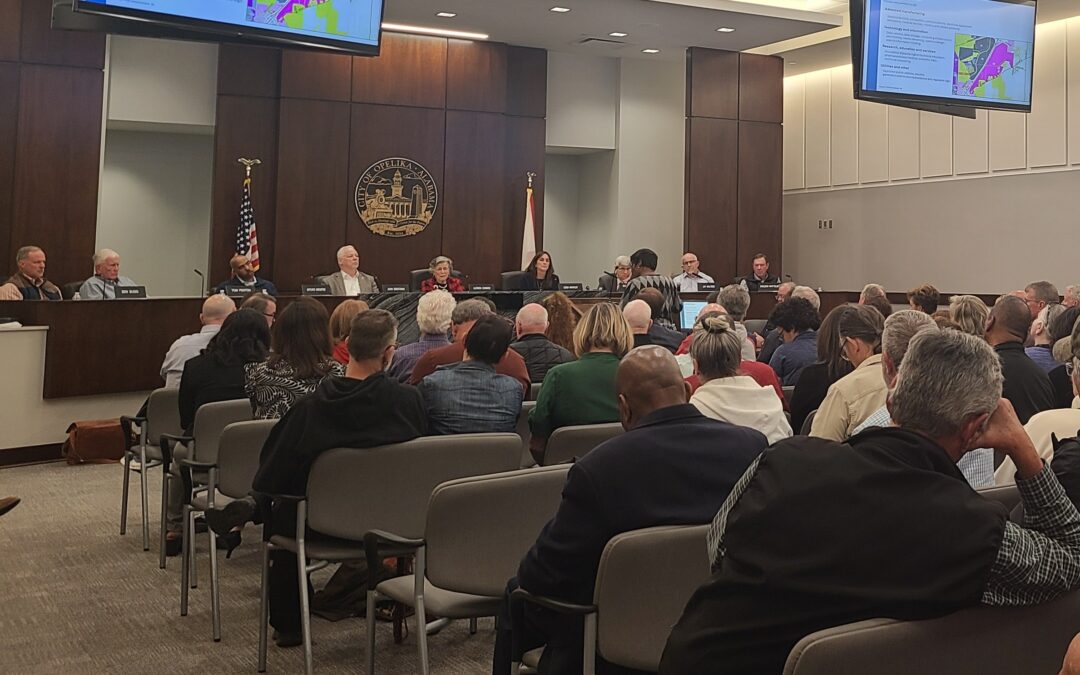
OPELIKA — A proposal to establish new technology-oriented zoning for the former Celebrate Alabama property drew more than three hours of presentations, public comments and an extended debate over whether the Opelika Planning Commission would retain sufficient control over future development.
By the end of the Nov. 17 meeting, commissioners had voted to recommend creating a Technology Overlay District, or TOD, with two sets of amendments and separately recommended applying the classification to approximately 519 acres along Interstate 85, Andrews Road and West Point Parkway. Both recommendations now go to the Opelika City Council. Neither vote approved the construction of a data center or identified a company that would build one.
However, data centers still dominated the hearing. Residents questioned the demand such facilities could place on electricity and water systems, whether backup generators might become ongoing power plants, how low-frequency noise would be controlled, how many permanent jobs would result and whether the city could enforce restrictions against a large corporation. Others urged commissioners to distinguish between a data center and the broader technology park proposal, rather than rule out an entire category of industrial investment.
The meeting also included a confrontation over public participation. Commission Chair Lucinda Cannon ordered the room cleared after repeated episodes of cheering and clapping by members of the audience, then permitted the public to return. Leigh Whatley, a Planning Commission member and Ward 3 City Council Member, stood in support of those being removed and indicated she would also leave if they were not allowed to return to the meeting.
What the ordinance would and wouldn’t do
Planning Director Matt Mosley opened by explaining that the commission faced separate decisions: whether to recommend inserting the new TOD classification into the zoning ordinance and whether to apply it to the former Celebrate Alabama acreage. A proposed amendment to the city’s long-range land-use planning was also among the related agenda matters.
“Because these are ordinances, the city council would hold its own public hearing, take additional comments and typically vote on the second reading,” Mosley said. “No matter what happens today, this process doesn’t stop at the Planning Commission.”
The designation initially would require at least 400 contiguous acres and access to substantial infrastructure, including high-voltage transmission power and roads, water and sewer service. Its uses would be restricted to approximately 21 technology-related classifications, including semiconductors, aerospace, robotics, pharmaceutical and medical manufacturing, research, data processing and storage, and data centers. The proposal also listed electric-generation and utility facilities among potential uses, a provision that would become a central point of public criticism.
Mosley compared the proposed regulations with the existing Retail/Entertainment designation developed for Celebrate Alabama in 2007, when plans called for a massive shopping, hotel and entertainment destination. That zoning allowed unusually broad flexibility in uses and in rules governing parking, signs, noise, lighting, landscaping and setbacks.
“Because of the change nationally in retail trends, the likelihood of this developing in the way that it was ever envisioned is fairly low,” Mosley said.
He stressed that the proposed TOD contained fewer allowable uses than Opelika’s standard industrial classification and imposed standards covering building design, equipment screening, open space and buffers.
The original version of the TOD called for a 50-foot buffer next to residential zoning, 10% of the site devoted to open space and noise limits of 70 A-weighted decibels during the day and 65 at night, along with rules for generator enclosures and testing. It limited light at property lines to one-half foot-candle, prohibited untreated groundwater use for cooling and required an agreement concerning water and wastewater before an actual user could proceed.
Mosley said, even after any rezoning, a developer would have to present a general concept site plan showing building footprints, access, landscaping, buffers and infrastructure for commission and city council review. Whether those reviews would give commissioners the ability to reject an otherwise compliant project became one of the meeting’s most important disputes.
The development case from Breland Companies
John Sweatman, Opelika’s economic development director, told commissioners the city was running short of large contiguous industrial sites. Although about 400 acres remained in its Northeast Opelika Industrial Park, he said the largest single available tract was about 100 acres. He said Opelika had been unable to compete for several prospects needing larger properties.
Shane Davis, director of land development for Breland Companies and a former Huntsville economic development official, presented the company’s vision for what it calls Opelika Technology Park. He described the proposed district as a way to compete for companies in growing technology industries rather than an approval of a particular occupant.
Davis said Breland was not a party to the original Celebrate Alabama development agreement.
“We are not party to that development agreement. Breland Companies has no nexus or involvement in that existing development agreement,” he said.
He also said the developer was not seeking financial assistance to develop the park.
“We’re asking for no funds, no development agreement to help us develop Opelika Technology Park,” he said, describing the proposal as privately funded.
That statement concerned development of the park itself; it did not establish whether a future industrial occupant might request incentives or enter its own agreement with the city.
Davis was direct about the question drawing the crowd.
“The data center question, would the proposed TOD zoning allow data centers of permitted use? Absolutely. Absolutely,” he said. “We do not have any pending deal with a data center.”
But he also stated, “We are actively pursuing uses, including a data center, that would be within the TOD uses.”
Davis told commissioners the company had spent nearly a year examining the area before bringing forward the zoning request. He argued that properly tailored zoning would allow future users to invest with confidence that adjoining facilities would be compatible, rather than permit any use available in a broadly defined industrial district.
“Today is not about approving a project. It is just not,” Davis said. “Any future development for Opelika Technology Park has many hurdles to go forward.”
He said potential users would still need to submit plans and seek approvals from local government and utility providers.
Much of Davis’ presentation centered on a Meta data center campus in Huntsville, which he offered as an example of the investment and revenue a technology-based development could generate. He described successive phases of construction, hundreds of permanent and supporting jobs, tax receipts, nonprofit contributions and noise monitoring near residential areas. Those figures were presented by Davis as evidence for his case; they were not measurements of any proposed facility in Opelika.
Davis said, during his tenure in Huntsville, the city had received no noise complaints involving the Meta campus. He also described water usage as lower than local utility officials originally anticipated. Residents later challenged whether that one example was a suitable basis for Opelika’s decision and whether another company’s facility would operate in the same way.
Public hearing: Power generation, noise and enforceability
Cannon opened the first public hearing with a five-minute speaking limit. For approximately 90 minutes, residents and technical professionals raised objections ranging from utility capacity to the wording of individual ordinance provisions.
Kelly Corno, who identified herself as a software engineer with more than 20 years of experience, challenged the developer’s employment and electric-grid assumptions.
“Whether we’re paying for it or not, it’s still taking from our grid. It’s still our usage,” she said.
Corno urged commissioners to investigate independently rather than rely solely on figures provided in the presentation, and she questioned whether a relatively small number of permanent jobs would justify the demands of a large facility.
Travis Smith, an Auburn University researcher who said he moved his family to Opelika by choice, questioned promises of a strong STEM employment pipeline from a data center. He distinguished between supporting a technology district and permitting the use most residents had come to challenge.
“I’m okay with the TOD designation. What I’m not for is for data centers,” he said. “If this company is interested in a technology park, we should consider a technology park by still banning data centers.”
Russell Kemp, a consulting industrial engineer who said he had spent 37 years working on environmental mitigation and compliance, delivered one of the hearing’s most detailed critiques. He focused on the proposed text, not simply on whether a data center should locate on the property.
Kemp warned that provisions naming electric power generation as a primary use and allowing energy-generation facilities as an accessory use did not expressly limit combustion-powered equipment to emergencies.
“The primary use could just be a power plant,” he said.
He asked commissioners to consider what could happen if a technology tenant never materialized but the zoning remained in effect.
“Suppose the anticipated technology project that Mr. Davis is pursuing never proceeds, but this ordinance does,” Kemp said. “What prevents any current or future land owner from developing a standalone merchant power plant under item 6U, selling the power offsite and claiming that power generation is permitted by right?”
Kemp recommended striking the broad generation provisions and allowing fuel-combustion equipment only for emergency or backup use and periodic reliability testing. He also objected to exemptions from noise restrictions for generator testing and other power operations.
“The standard should protect surrounding residents regardless of which equipment or activity produces the noise,” he said.
He additionally called for a prohibition on open-pile burning of land-clearing debris.
Chris Deason, a middle school teacher, pressed officials about the permanence of utility-cost protections, the possibility of incentives for a future user and whether public discussion was occurring early enough.
“Can we please include in the new zoning a restriction on data centers, like no data centers at all, and develop our technology park without data centers?” he asked.
He also raised concerns about livestock, bees, groundwater and the difference between promises made about a hypothetical project and enforceable language in the ordinance.
Sarah Dewey, a Ward 3 resident, said she created an online petition after learning the proposed district would allow data centers. She reported 5,083 verified signatures as of noon on the day of the hearing, a figure she presented to commissioners.
“There are 21 options. Leave the 20 in and take the data center option out,” she said.
She also urged clearer future meeting agendas so residents could readily identify when data centers might be considered.
Harry Atchinson described working at a sawmill where he said sewage and noise problems had been contemplated in the original plan but remained unresolved.
“I asked my employer why and was told it was easier to pay the fine than to fix the problem,” he said.
His point was not only that the TOD should establish rules, but that the city should consider whether a future operator would find compliance more worthwhile than paying penalties.
Sean Crowell, who identified himself as a civil design engineer and said he had written overlay districts, echoed Kemp’s concerns about temporary generating equipment.
“That temporary solution quickly becomes semi-permanent,” he said, describing how a project could rely on temporary power when local supply proved insufficient.
Crowell urged changes to the generation language and opposed permitting data centers and unrestricted power production as allowed uses.
Norma J. Sanders, who identified herself as housing chair of the Lee County NAACP branch, asked for legally binding safeguards on water consumption, utility infrastructure costs, low-frequency noise, generator hours and residential buffers.
“We ask that you require legally binding conditions before any rezoning is granted,” she said.
She asked the commission to mandate closed-loop cooling, require the developer to pay for infrastructure upgrades and protect nearby households against increased costs.
A confrontation over who could remain in the room
Audience members applauded speakers and reacted audibly during the hearing. Cannon warned the crowd about maintaining order and eventually directed that the room be cleared, initially allowing those seeking to speak to return individually.
Several people loudly objected to the order. Whatley, a Planning Commission member and Opelika council member, stood in support of the residents and indicated she would also leave if the public could not return.
Cannon ultimately reversed course. She told those present if they could refrain from clapping and disruptions, “then everybody [can] come back in.” She instructed that people return quietly, and the hearing continued.
Residents challenge the broader effects
Morgan Kearns said Opelika needed development that served residents and argued that the city’s existing infrastructure and neighborhood needs deserved greater priority.
“Yes, we need growth in Opelika. Absolutely we do. We need this growth to be for us and not for companies,” Kearns said.
Kearns also questioned potential effects from lighting, exhaust, water contamination and noise and noted the lack of a grocery store in north Opelika.
Nicole Sumner, whose West Point Parkway home borders the property, spoke about the wildlife, woods and privacy that had attracted her to the location.
“I don’t want to get up in the morning and see a building in front of me,” she said. “Please consider the people in the neighborhood of West Point Parkway.”
Her comments underscored the immediate impact that rezoning could have on adjacent landowners, regardless of the technical details of a future project.
Melissa McConnell emphasized Alabama’s biodiversity and argued environmental effects should be evaluated alongside economic projections. She also raised the Celebrate Alabama lawsuit and speculated that rezoning might be connected to resolving it. That was a concern expressed by a resident, not a demonstrated connection.
“A lawsuit’s going to hurt our city,” she said. “This is actually a bigger problem than most people think it is.”
Henry Tanner, a recently arrived resident who described military, environmental-safety and emergency-response experience, worried about noise, property values and how firefighters would respond to a large power-intensive facility.
“Think about if your house is in that area, would you want it there?” he asked, urging commissioners to consider potential hazards and costs from a neighboring homeowner’s perspective.
Albert Desmarais, a retired Navy commander and nuclear engineer, offered a more conditional argument. He said many allowed technology uses, not just data centers, would require careful analysis of cooling, runoff, power and safety.
“Can data centers be installed safely? Yes, they can,” he said. “But you have to make sure and your responsibility is to make sure that you do the due diligence to make sure those concerns are addressed.”
He encouraged officials to examine actual cooling systems and operating plans rather than assume all facilities posed identical risks.
Dustin Deshazo, another software engineer, said he wanted technology careers for local young people but did not believe data centers would deliver the same employment as engineering and software-development businesses.
“We can do this technology park, I feel, without a data center,” he said.
Deshazo also questioned how long utility cost protections would remain in effect under service contracts.
Emily Riedel, who said she returned to Opelika to raise her family, argued that affordable housing, utility bills and the area’s character should carry as much weight as corporate investment.
“We want to have a home for the children to come back to,” she said. “And if you sell it off to data centers, our homes are not going to be homes anymore.”
Stephanie Graham drew a distinction similar to that made by several other speakers.
“I am not opposed to the technology park itself. I am vehemently opposed to the data center,” she said.
She questioned how Opelika could contemplate a major new energy-intensive development while restricting some residential growth because of infrastructure concerns, and she distinguished temporary construction employment from long-term jobs.
Robin Weyant recalled the optimism surrounding the original Celebrate Alabama project, reading from a favorable statement made by a city leader in 2007. She asked what assurance residents had that a new concept would turn out differently as technology and business conditions changed.
“How do you know that technology isn’t going to change to make data centers obsolete?” she asked.
Weyant also questioned whether litigation over the earlier development might be influencing the new proposal, a connection not established at the hearing.
Victor Vance, who said he owned commercial property in the corridor, praised the site’s value but argued using it for a large data center could foreclose other economic possibilities.
“You’ve wasted what is absolutely one of the better sites on Interstate 85,” he said, questioning the permanent job count and whether a prospective user might later request tax abatements. “A data center according to my research employs very few people; It makes no product; It performs no service for the community.”
His remarks reflected a position favoring industrial recruitment but urging a different use for that land.
Lynda Jackson spoke about priorities she believed deserved attention before a major new project, including affordable housing for older residents and access to reliable water in rural portions of Opelika. She described households with wells running dry and residents forced to purchase water.
“We need to fix the things that we need done here first before we go do something big,” she said. “We need to do the small stuff first.”
Terry Horn, a retired biomedical engineer whose family property borders the site, said he had voiced concerns about Celebrate Alabama nearly two decades earlier. He urged commissioners to consider that neither developers nor officials could predict what the market or the technology would look like years later.
“We were told how great Celebrate Alabama was going to be. No one knew the economy was going to tank a year later,” he said. “And that’s my point.”
Horn disputed the suggestion that neighboring residents would necessarily experience negligible noise from a future facility.
Scott Dulaney, who said he was not categorically opposed to data centers, focused on whether the zoning itself provided enough protection.
“Consider how wide a gate you are opening through which development for this parcel will run,” he told commissioners.
Dulaney cited gas-turbine generation at data center projects elsewhere and urged officials to write the ordinance for uses they might not yet anticipate.
Dean Odle raised concerns about water supplies, surveillance and the potential use of artificial intelligence to collect information on residents. He also objected to restrictions on audience reactions during the hearing.
“Respect the First Amendment rights of the people to clap or cheer, whatever,” he said at the end of his remarks, arguing that officials should welcome public involvement. His assertions about technology and surveillance were his own and were not independently established by the hearing.
Bradley Bearden, a mathematics and computer science teacher, said commissioners should not approve an ordinance simply because the statutory notice period had been met. He called for enforceable protections and additional time for residents to examine the text and identify loopholes.
“We get one chance to get the language correct,” he said.
Lee McInnis, who identified himself as a historian, acknowledged the developer’s Huntsville example but questioned whether Opelika would possess comparable resources to pursue a large corporation that violated its rules.
“Opelika is not Huntsville,” he said.
He asked commissioners to consider “if the end user decides to violate our codes, violate environmental safety standards, will the city of Opelika be able to fight that fight?”
Commissioners debate whether future approval would be meaningful
After Cannon closed the first public hearing, commissioners began their own lengthy discussion. Whatley said residents deserved more advance information and clearer explanations about data centers and the proposed zoning. She said her position concerned public trust and the process for reviewing any eventual project, rather than a decision on a specific data center that was not before the commission.
“Our citizens deserve to have all these fears and concerns addressed,” Whatley said. She also stressed that her vote was about putting a transparent process in place rather than deciding the merits of a specific facility.
Commissioner Sheldon Whittelsey proposed adding conditional-use approval by the Planning Commission for any development in the TOD. He said ordinary concept-plan review would not give the commission enough ability to evaluate detailed architectural and civil plans or protect residents if unforeseen problems arose.
“The citizens of Opelika deserve and expect their planning commission to approve the plans and uses that fall within the zoning regulations,” Whittelsey said. “We must have full clarity, and it must be transparent going forward.”
Mosley explained that the proposed Section 12 already required a general concept site plan covering the approximate footprint and size of buildings, access points, roads, landscaping, security improvements, buffers, setbacks and utilities. That plan would return to both the Planning Commission and City Council. But he also explained that the existing process focused on whether a project met the standards the ordinance prescribed, not a free-ranging reconsideration of whether an otherwise permitted use should be allowed.
Commissioners pressed the distinction, asking whether approval of the zoning would eventually allow a data center even if commissioners later opposed that type of facility. Mosley said a specific proposal would still need concept-plan review and applicable utility approvals; he described the City Council’s authority to review a water service agreement and potentially reject a proposal on that basis.
Whittelsey argued that conditional-use approval would provide a stronger opportunity to assess the actual facility and attach conditions. Developers, including Lewis Breland, objected to adding an unpredictable extra approval process that they said could discourage companies from considering Opelika. The debate exposed the central policy question: how much review should occur after a use has already been expressly allowed in the zoning code?
The commission adopted Whittelsey’s conditional-use amendment. The available working transcripts establish passage but do not support a reliable numerical vote tally.
Walters proposes tougher noise, buffer and testing standards
Commissioner Jay Walters then proposed a separate package of amendments, saying he had consulted other communities about issues encountered with data centers. He emphasized concerns residents had raised about noise, power and potential long-term effects.
Walters proposed lowering the original ordinance’s daytime A-weighted noise limit from 70 to 55 decibels and its nighttime limit from 65 to 50. He also proposed C-weighted limits of 73 decibels by day and 68 at night to address lower-frequency sound, increasing the residential buffer from 50 to 100 feet, and limiting generator testing to 8 a.m. to 5 p.m. Monday through Friday, excluding holidays.
He questioned a provision excluding on-site generation, substations and distribution facilities from certain noise rules. Davis responded that electric utilities control whether customers may generate power under their power-service arrangements, while Walters emphasized that his concern was whether any equipment operating on the site would be exempt from local noise limits.
The discussion also turned to height. Walters sought to hold primary buildings to 75 feet while permitting taller accessory structures, such as water towers, under the applicable restrictions. A proposed decommissioning requirement would have addressed facilities left vacant or unusable after a technology company departed. The developer’s representatives argued that a vacant building might remain valuable and suitable for reuse, and Sweatman discussed how future development agreements could deal with nonperformance. Walters withdrew the decommissioning proposal for possible later consideration.
As clarified immediately before the vote, the second amendment covered the tighter noise limits, increased residential buffers, restricted generator-testing hours and height limitations; the decommissioning language was not included. The commission voted to adopt the amendment, then voted to recommend approval of the TOD ordinance with both amendments.
Second hearing: Would the new overlay apply to the property?
The commission then turned to the separate request to apply the TOD to the former Celebrate Alabama parcel. Because another city meeting was scheduled, commissioners and staff discussed whether to postpone the hearing, recess to a definite date or continue. Some participants said people who had already remained for hours should not have to return to make their voices heard. The commission proceeded with the second public hearing.
Steve Scott, who said he owned two properties bordering the tract and had lived alongside it since childhood, questioned whether required notice had reached neighboring owners.
“I did not get a legal notice of this meeting,” Scott said. “Can this meeting be legal without me receiving a notice of it?”
He also described the proposal as a possible backdoor route to a data center and said officials were losing residents’ trust.
Tom Turkington, who owns property near the proposed development, said he was not necessarily opposed to a data center but wanted to ensure the city maintained control over what could be built on the property.
“I didn’t come here today to tell you to approve or reject any of these things,” Turkington said. “I just think that if this is going to happen, it needs to happen on Opelika’s terms.”
He urged commissioners to establish appropriate zoning requirements addressing lighting, noise, abatements and other potential impacts before allowing development to proceed.
“Whoever builds this thing eventually needs to meet the standards that are good for this community and good for the people of this community,” he said.
Turkington also emphasized that opposition to data centers was not universal among residents.
“Not all the citizens of this community are against a data center. I’m not against a data center. I want whatever is built here to be appropriate and good for our community,” he said. “A data center can be under the right situation, but it could also be a disaster.”
The commission closed the second public hearing and voted to recommend applying the TOD classification to the 519-acre tract.
The Celebrate Alabama lawsuit and the alternative proposal
The property’s development history is also the subject of a pending lawsuit. Opelika Investment Properties LLC sued the city in Lee County Circuit Court in 2024 over the original Celebrate Alabama development agreement approved in 2007. In a first amended and restated complaint filed Sept. 23, 2024, the company alleged that the city improperly blocked or delayed development permitted under that agreement. The city has disputed the developer’s characterization in previous public reporting.
The developer alleges that it lost an anticipated agreement to sell about 151 acres to LGI Homes for approximately 400 residences. According to the complaint, the proposed land sale and associated assessments would have generated more than $20 million. It also alleges interference with a separate 2024 plan for a proposed 90,000-square-foot retail facility and phased infrastructure construction.
The complaint seeks compensatory damages potentially exceeding $300 million, plus development profits and other relief. That is the amount claimed by the plaintiff, not a judgment, settlement amount or independently established financial loss.
A Sept. 2, 2026, joint status report filed by attorneys for the city and Opelika Investment Properties confirms that the parties had discussed a possible alternative to the original development concept. “Plaintiff Opelika Investment Properties LLC is pursuing an alternative development proposal that could result in a resolution to these proceedings,” the filing states. “The Parties continue to confidentially discuss the proposal.”
The joint report refers to an Oct. 15, 2025, motion to stay the litigation and asks the court to continue a September 2026 status conference while discussions proceed. Neither that September report nor the complaint identifies the TOD request as a negotiated settlement, and the records provided do not establish that rezoning would resolve the lawsuit.
The Observer has reached out to the city of Opelika with questions about whether the proposed Technology Overlay District is related to the alternative development proposal referenced in the court filing, whether the city is considering a new or amended development agreement and what additional public approvals might be required.
The Observer has also reached out to the Silver Company, the developer associated with the original Celebrate Alabama project, seeking clarification about its involvement in the proposed redevelopment and any potential connection to the pending lawsuit.
The lawsuit is Opelika Investment Properties LLC v. City of Opelika, Lee County Circuit Court case CV-2024-000254.
What happens next
The zoning text amendment and the proposed overlay for the former Celebrate Alabama property now proceed to City Council consideration. Following another public hearing and introduction of the proposed zoning, the council may adopt, reject or otherwise act on the proposals under the applicable process. Any future project would also face the review and permitting requirements in the ordinance ultimately enacted.
For many of the residents who attended the Nov. 17 meeting, the issue was not whether Opelika should pursue new technology-related industries, but whether a data center should be among the uses permitted on the property. Despite the commission’s decision to strengthen the proposed ordinance with additional safeguards, residents repeatedly urged commissioners to remove data centers from the list of allowable uses altogether. The commission’s recommendations retained data centers a
