
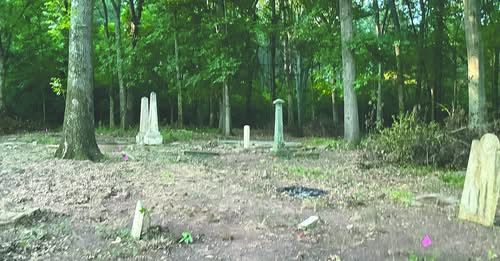
BY THE LEE COUNTY CEMETERY PRESERVATION COMMISSION
OPINION — At recent Opelika City Council meetings, citizens communications related to the Hodge Cemetery were made. What is going on, and why?
Hodge Cemetery in Lee County was originally located in Chambers County. That part of Chambers County became Lee County in December 1866.
A copy of the deed wherein John Hodge (1773 – 1864) bought the property Nov. 3, 1858, from William H. and Susan C. Tucker was recorded in Chambers County. Members of the Hodge family, including Mr. and Mrs. John Hodge, are interred in this cemetery. The name, Hodge Cemetery, is historically correct. As of May 2024, Hodge Cemetery was listed on the Alabama Historical Commission’s Cemetery Registry. Opelika’s Planning Commission and City Council were given Hodge information.
The John Hodge (1773 – 1864) Will from Chambers County, Ala. was dated Nov. 3, 1857. The very first item of the will states: “First: I direct that my body be decently interred in the family burying ground on my own premises … .” He did provide additional instructions. However, this verifies that Hodge Cemetery was established with both a deed and a will. According to known death dates, John Hodge was not the first interment at Hodge Cemetery. Susannah Tucker Hodge, his wife, died about 1860. Probably, the first burial at Hodge Cemetery was Isaac P. Mooney (1795 – 1844), who married Susannah Hodge, daughter of John and Susannah Tucker Hodge. There are 95 known graves at Hodge Cemetery with likely more.
Troubles have been distressing with this cemetery. The name and ownership have been deliberately corrupted. A widely accepted view: “History must be accepted as it unfolded” was disregarded.
Sons of Confederate Veterans is a well-respected heritage organization. Please keep in mind the following is offensive and was opposed in writing by Alabama State SCV Commanders when it happened.
On July 26, 2002, two men from Montgomery filed a quitclaim deed in the Lee County Probate Office. According to the deed, for $50 one sold the cemetery to SCV Yancy Camp No. 1592. This deed is bogus. Imaginary Yancy Camp No. 1592 was just that. It did not exist. This seller had no right to sell. According to an article by Lindsay Demers, a Baldwin County, Alabama, attorney posted to Google: “…One of the most significant legal distinctions is that Alabama is what’s known as a “buyer beware” state. That means the burden is on the buyer to thoroughly inspect and investigate the property before purchasing.
According to an article on www.ldemerslaw.com, sellers in Alabama are not required to disclose all known defects, which means that if you don’t ask the right questions — or if something slips through the cracks — you could be stuck with serious issues after closing… .”
In the bogus deed, exactly which acre did he sell? Are the imaginary SCV Camp, and their heirs, owners of this property? The property ownership records for the imaginary Yancy SCV Camp 1592 Cemetery in Lee County remains addressed to the name of one of the real sellers. Both men from Montgomery are deceased.
These men had their way and work ended at Hodge. The lack of common respect was appalling. They had trees cut on property that was not theirs. When trees are cleared from a cemetery, the protective canopy is gone. Sunlight brings scrub, vines and weeds, which grow vigorously. That is exactly what happened at Hodge. In a short time the cemetery was badly overgrown.
In 2002 and 2003, a local bill was introduced in the Alabama Senate by Sen. Ted Little. Rep. Mike Hubbard introduced the same bill in the House of Representatives. It created the Lee County Cemetery Preservation Commission beginning in 2004. Prior to this bill, Resolutions from the Lee County Commission, and city councils of Auburn and Opelika were passed supporting this legislation.
Later, hunters rented the land. They locked the gates. All access to the cemetery was denied. One hunter died from COVID-19. Tiffany Hilyer, chair of the Lee County Cemetery Preservation Commission, had been clearing away vines and scrub from the cemetery. Although state laws guarantee access to cemeteries — these people ignored the law. Vines and scrub grew stronger.
Now comes Blackberry Reserve, a large, dense, residential development. There is an old deed setting aside one acre of land for the cemetery along with ingress and egress. The Blackberry plat does show the cemetery; however, therein is the problem. The one-acre set aside for the cemetery is not centered over the actual cemetery. On the east side, the foot of one grave is about three feet from the edge of a designated paved street. The street is not cut or paved yet. There is time to remedy this problem. Hilyer and Tom Morris, both with the LCCPC, have addressed the Opelika City Council with these concerns. They requested a buffer of 25 feet beyond the last known grave could allow for unmarked graves. The Alabama Historical Commission recommends a 100-foot buffer. Presently, there are no Alabama laws or Opelika ordinances addressing this issue.
Ground penetrating radar has been used at Hodge Cemetery. There are different types of GPR. Radar used at Hodge was owned and operated by the developer and/or owner of Blackberry Reserve. Interpretation can vary on GPR results by different operators, and can result in different outcomes. On the day this scan was made, the radar’s battery quit. LCCPC members were present when this work was done. The operator was experienced with that equipment. However, was a complete scan done? The problems are: the closeness of a street to a marked grave, uncertainty of unmarked and unknown graves on the north and east borders.
Two churches, St. Mark and Union Hill, held funerals there as late as the 1980s. The actual cemetery likely is more than the one acre.
The cemetery was badly overgrown when the Blackberry plat was prepared. Is it fair to understand the surveyor’s dilemma over the cemetery border’s proximity to the street? Yes, but, understanding does not solve the problem.
Hodge Cemetery has been cleaned by the efforts of LCCPC. It was done in several work sessions by Hilyer and her husband; Kim Johns and her husband along with volunteers from the Lee County Detention Center. Therefore, clearly now it can be seen a 25-foot buffer is badly needed. There is time to redraw the location of the proposed street. Other modifications to two lots on the north boundary was also requested. Hodge needs a continuing plan of maintenance, too. Additionally, LCCPC can provide maintenance. For that to happen, donations will be necessary, especially labor. LCCPC as currently established cannot provide perpetual cemetery maintenance at Hodge Cemetery.
LCCPC has earned an excellent 22-year history of doing exactly what they were created to do: protect the cemeteries in Lee County. LCCPC members are appointed by the Lee County Commission. They receive no compensation. LCCPC is also an Alabama Corporation, and an IRS 501(c)(3) nonprofit, tax exempt, charity entirely supported by donations. The original five LCCPC members made personal donations to pay to form the corporation.
It is understood land owners can sell or develop their land. Further understood, developers want to earn a profit; agreed and noticed — profits are sometime in the millions.
Why can not this cemetery name and boundary be resolved more respectfully? Who will do it?
