
BY NOAH GRIFFITH
FOR THE OBSERVER
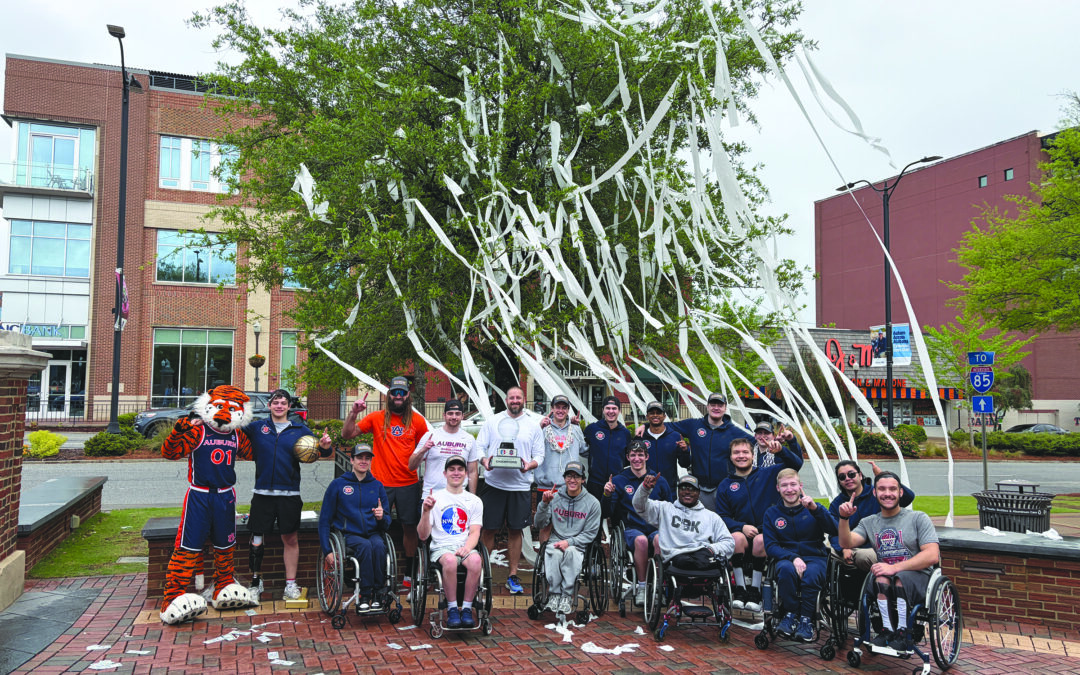
AUBURN — Auburn University’s wheelchair basketball team captured its first national championship victory Saturday, a milestone more than a decade in the making.
Since the program’s inception in 2015, head coach Robb Taylor has built the program from the ground up with a culture based around high character, hard work and great pride. They dreamt of being a program the Auburn family could be proud of.
That vision became reality on April 4, when they defeated the top-seeded Alabama Crimson Tide, 70-59, in the program’s first national title game. The win made Auburn champions of the National Wheelchair Basketball Association national tournament in Tucson, Arizona.
“This win is possible because of the trailblazers and the folks that believed in Auburn and believed in what we were trying to build,” Taylor said. “The team is reaping the rewards of all the work those people did. This is what is possible when everyone is pushing in the same direction and doing it for the person next to them.”
The No. 2-seeded Tigers won three games in the tournament after earning a first-round bye.
Auburn started on Thursday by edging a 69-59 win over a hot-shooting AJ Fitzpatrick and No. 7 seed UW-Whitewater. Friday, Auburn rolled past No. 6 seed Southwest Minnesota State University, 83-54, in the Final Four to set up a championship matchup with No. 1-seeded Alabama on Saturday afternoon.
Auburn finished the season with a program-best 29-7 record, including going 16-0 in the calendar year 2026. The remarkable season follows a 28-12 campaign in 2024-25 that ended with a fifth-place finish at last year’s national tournament — one spot behind rival Alabama.
This year, a balanced blend of newcomers and upperclassmen propelled Auburn to national prominence. The Tigers showcased their offensive firepower with a 110-point performance against UW-Whitewater and a 92-21 drumming of the University of Michigan in the Wolverine’s inaugural season. Auburn also split the regular-season series 3-3 with Alabama after struggling against the Crimson Tide in previous years.
“What a fitting way to end things — winner-take-all championship,” Taylor said on Friday night after finding out they would face Alabama in the title game. “Regardless of the outcome, it will be the highest finish in program history. Something I am very proud of.”
In Saturday’s championship game, Auburn also snatched a 4-3 advantage in the season series with Alabama, who was awarded the No. 1 seed in the tournament despite an 18-5 record and the split in the head-to-head with Auburn.
Auburn shrugged off 4-0 runs from Alabama to start each half of the title game, along with a 35-34 deficit at halftime. The scoring threats of Preston Howell and Justin Newman came out strong for Alabama, but Auburn’s defense locked in during the second half and junior Jude Hiley caught fire with 11 points in the fourth quarter.
The Tiger defense limited Alabama to 24 points in the second half, and each of Auburn’s top three scorers stepped up to the plate one last time. Freshman phenom Drew Beutel finished with 23 points and seven assists, senior and program leading scorer Jake Eastwood dropped 19 points with six assists, while Hiley finished with 17.
Hiley’s late heroics helped him take home the tournament MVP honor. He tallied 39 points, seven assists and several key steals among the three tournament games.
Alongside Hiley’s stellar showing, Auburn had several clutch individual performances throughout the tournament. Beutel led the team in scoring with 56 total points, sophomore Adam Smith led the team with 16 assists and junior Ben Edwards provided relentless energy and hustle when he subbed in with the team struggling against a hot UW-Whitewater team.
“In the moment, I was honestly a little surprised I won the MVP due to great performances from both Drew and Jake,” said Hiley, an Atlanta native and Team USA U23 player. “I tend to forget a lot of what happens in games, especially when they’re that intense. So, once my teammates reminded me how hot I got in the fourth quarter, I felt better about it.”
The monumental win and the program’s remarkable success all starts with Taylor’s specific recruiting strategy from the beginning. He wanted guys who never wavered in their determination and who wouldn’t stop to get Auburn to the top.
The top is where they sit now, and, to fully appreciate the process, Taylor went all the way back to 2010 — before wheelchair basketball was even born on the Plains.
“Thinking back to my first year and where we’ve come in the 10 years is a great sense of pride,” Taylor said. “Our program started with one student-athlete, Dr. Jared Rehm. He, along with Nathan Waters, started Auburn Adapted Athletics in 2010. We started as a wheelchair tennis program — wheelchair basketball wasn’t added until a few years later.”
Taylor took over as head coach of the wheelchair basketball team in 2016. The team started with athletes such as Philip Crain. Then came Taylor’s first recruit with Fisher Rizk, preceding program-defining recruits like Zach Dickey, who is now the team’s assistant coach and started a new adaptive sports program at Auburn with power wheelchair soccer.
Taylor listed many other athletes before fast forwarding to today’s championship squad. The three seniors on the team — Eastwood, Evan Heller and Jay Denning — have each achieved incredible accomplishments in their Auburn careers.
Eastwood is the program’s leading scorer with 2,683 career points along with over 1,200 rebounds and 1,000 assists — only the second college basketball player to join all of those categories, along with women’s basketball star Sabrina Ionescu at Oregon. Heller is the program’s second leading scorer with over 2,000 points of his own. Denning anchored the defense and was one of the most influential leaders on this championship team.
“Losing all three of them will be a big loss for our program,” Taylor said. “What they were able to do here is historic and will never be forgotten.”
Denning joined the team in 2021 after playing before college in Nashville for the Music City Thunder. He joined the Tigers, alongside Eastwood, with the goal of elevating Auburn to a championship level. A championship program is just how he will leave it.
“I wanted our legacy to be that we were the ones to get that national championship,” Denning said. “It sounds cliché, but I really wanted to help elevate the program’s level of play and be one of the firsts to get coach Robb and the program the recognition they deserve.”
It was a long climb to this peak, but Taylor’s vision for adaptive sports at Auburn continues.
His next mission is to help the wheelchair tennis team become the third adaptive sports team at Auburn to win its first national championship within a year when they travel to Orlando this week. The power soccer team won its national tournament last June in addition to wheelchair basketball’s title.
As for wheelchair basketball, he hopes to sustain his team’s success in a growing sport. The University of Michigan was the newest collegiate team to join the 12-team field in the national tournament this year, and schools are bound to hop on the trend and form new teams.
The bigger picture for Taylor is to use this success to foster more support for adaptive sports athletes and teams. The next step is to work with Auburn University to find a permanent home for adaptive sports teams, as well as increase staffing and funding for them. He desires the same level of respect for his student-athletes as their able-bodied counterparts.
“We are just beginning. What we just accomplished will seem easy compared to what I’d like to push for,” Taylor said. “Time for everyone to hop on board and move with us. Imagine the impact we could have.”
