
BY DANIEL SCHMIDT
THE OBSERVER
OPELIKA — One hundred and fifteen days. That was the time the Boswell family spent living between hope and fear, watching their infant son, Davis, connected to machines and wondering if they would receive a call telling them he was a match for a heart before the enterovirus he contracted killed him.
That call came after six-month-old John Clarke Perry tragically passed away in Monroe, Louisiana due to an abnormal blood vessel formation in his brain and subsequent bleeding.
To commemorate the connection they now shared, the two families held a Donate to Life ceremony at East Alabama Medical Center in April 2016 honoring John Clarke and celebrating Davis.
Today, the event is still going strong and celebrated its 10th anniversary on April 1 in the same main lobby where it was first held.
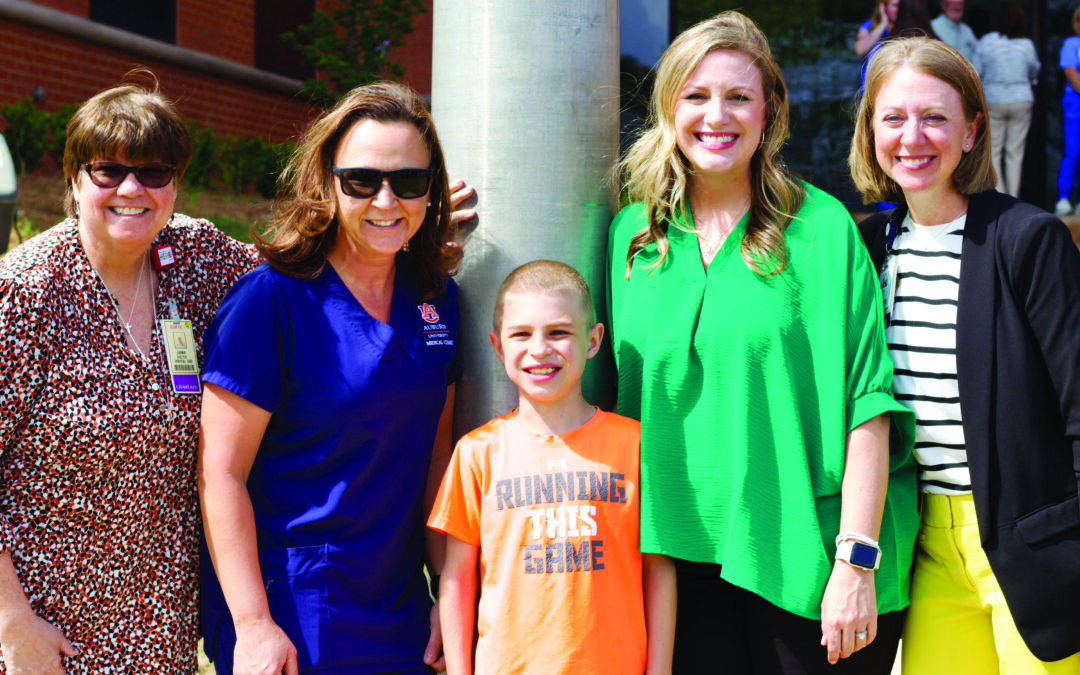
With dozens of medical professionals, community members and local officials in attendance, Davis’ mother, Amanda Carpenter, said the attendance for such an important milestone was overwhelming.
“We’re just still incredibly grateful, that never changes,” Carpenter said. “The emotions of seeing the video again, the emotion of talking about it, it never fails. And we’re just so thankful every day that he gets to do something, like starting [track and field] this year. That’s a new thing for him, and just to see him be able to do those things is amazing.”
Now almost 11 years old, Davis is thriving. He’s participated in youth baseball and soccer, has recently become a track and field athlete specializing in short-distance sprints and excels in school. In every conceivable way, he is a normal, healthy boy despite being in need of major medical intervention as a baby.
At an event urging the broader public to consider becoming organ donors if they are not already, his life story has become a testament to the value of organ donation. While the circumstances surrounding the procedure can oftentimes be tragic, it also serves as a precious, invaluable gift, according to Carpenter.
“We often talk about organ donation as a gift of life, and it truly is, but I want to take a moment to say this clearly: that gift comes wrapped in loss [and] from families who are experiencing the worst day of their lives and still choose to think of others,” Carpenter said. “The Perry family didn’t just give us a heart. They gave us birthdays, first days of school, baseball games and family vacations. They gave us a future we didn’t know if we would have. And over the past 10 years, something else has happened: they became part of our family.”
At the event, Auburn Mayor Ron Anders and Opelika Ward 4 City Council Member Chuck Beams delivered a joint proclamation in support of the event and issued calls to action.
“Another person is added to the waiting list every eight minutes, and on average, 16 people die each day while waiting for a life-saving organ transplant,” Anders said. “Each transplant represents an individual, a family, a story and a life saved or improved, and each transplant also represents a selfless decision made by a grieving family or an inspired living donor. It’s incumbent upon us to honor each and every one of those irreplaceable gifts.”
Beams added that since there are more than 100,000 Americans, including more than 1,200 Alabamians, currently on the national transplant waiting list, the need for people willing to become organ donors has never been greater.
“By becoming an organ, eye and tissue donor, one individual can save and heal the lives of more than 75 people,” Beams said. “The most effective way to address this health crisis is to educate and to encourage citizens to commit the following actions: register your decision to be an organ eye and tissue donor at legacyofhope.org or at your local DMV.”
According to medical professionals present at the ceremony, one donor can save up to eight lives, restore eyesight to two people and heal more than 75 lives through tissue donation.
The list of organs and tissues that can be successfully transplanted continues to grow.
Here’s what can be donated:
Skin, veins, arteries and nerves
People of all ages and medical histories may consider themselves potential donors, though medical conditions at the time of death will determine what organs and tissues can be donated.
A national system matches available organs from the donor with people on the waiting list based on blood type, body size, how sick the recipient is, the donor’s identity, distance between medical facilities, the tissue type and how much time the recipient has waited for a transplant
Any adult age 18 or older can register to be an organ, eye and tissue donor. Fifteen-to-17-year-olds may register their intent to be donors through the national Donate Life Registry, though a parent or legal guardian must make the final donation decision until the underage donor turns 18.
Sexual orientation, gender, gender identity or expression, race, income and social status are never considered.
Doctors are required to provide the same quality of care to organ donors as they are to non-organ donors, and organ donation is only possible after patients completely and irreversibly lose brain function and are legally declared dead.
Donation is cost-free to the donor’s family, which will only need to cover medical expenses and funeral costs.
All major religions also support donation as a final act of compassion and generosity.
For more information about organ donation, visit donatelife.net or legacyofhope.org. Those interested in learning more about the Boswell and Perry families and their stories may visit johnclarkeperryfoundation.com.cyofhope.org. Those interested in learning more about the Boswell and Perry families and their stories may visit johnclarkeperryfoundation.com.
Organs: heart, kidneys, liver, lungs, pancreas and intestines
Tissues: eyes, cornea, heart valve, bone and associated tissue
