
By Kadie Taylor
The Observer
LEE COUNTY — Worthy2(squared) hosted a Behind the Screen… Who’s Really There? Protecting Our Children in a Digital World — An Internet Safety Workshop for Parents and Caregivers on Feb. 19 at Cornerstone Church in Auburn.
Kathryn Guthrie, founder of Worthy2, welcomed those in attendance and shared the purpose and need for Worthy2 in Lee County.
“We’re in our eighth year, and we are an advocacy organization for adult and minor females who have been exploited through commercial sex or sex trafficking,” she said. “I’m going to review a little bit about human trafficking, and then talk about some of the things that we’ve seen here locally in the last few years. So what is trafficking? Human trafficking is the unlawful act of transporting or coercing people in order to benefit from their work or service, typically in the form of forced labor or sexual exploitation. So we work primarily with sex trafficking, not really labor trafficking. So sex trafficking is any sexual service an individual is made to perform, through force, fraud or coercion. In Alabama, child sex trafficking is under 19. Most states it’s 18 and under, but [in Alabama] it is the recruitment, harboring, transportation, provision or obtaining of a child under 19 years of age for the purpose of a commercial sex act. So [this is done in exchange for] anything of value, so it doesn’t have to be money, can be a place to stay, can be food, it can be drugs, anything that is of value to them. And we always show this [graphic] where it says, ‘There’s no such thing as a child prostitute.’ But the way I really feel about it is that prostitute is a verb, not a noun, because these women are prostituted. No little girl ever said that’s what I want to be when I grow up.”
Guthrie said human trafficking is a $238 billion industry, commercial sex and exploitation is a $172 billion industry and girls account for 80% of the victims. Through using a software to search for victims of human trafficking, Guthrie said she works to find minor victims and share information with the Opelika Police Department to try get the victims help. With a photo of her daughter’s elementary school class on the screen, and the students’ faces covered to hide their identity, Guthrie said she wanted the audience to be alert and observant of vulnerable people around them and to be cautious themselves online, because “human trafficking does not discriminate” and in her daughter’s small elementary school class, one of the girls was trafficked.
“This is at a local elementary school in Opelika, and one of these girls was sex trafficked at 14,” she said. “So we work with law enforcement, and we were working with Opelika PD doing online outreach — 70% of commercial sex is done online. And so we go online, we go on our phone and we reach out to these women and girls that are listed for sale, and we ask, ‘How are you?’ ‘Are you okay?’ ‘Do you need help?’ ‘You need medical help?’ ‘Do you have food’ and that kind of thing — just to let them know somebody’s out there. I had identified this one young girl as a minor. You could tell because she didn’t have a lot of tattoos, her skin wasn’t really broken up from drugs. She just looked young. And usually, if it’s a minor, they don’t show their face. So, I called our detective at OPD and said, ‘Hey, this girl’s a minor. See what you can do.’ So they’ll set up what’s called a play or a date and they did that with this young girl. [The officer] called me about her a few days later, and told me I had to come down to [the station at] 11 p.m. I go down to OPD, and I say, ‘What’s her name?’ And he tells me, and I almost went to my knees, because I know this girl — I know her mama, she’s from here. And she started acting out a little bit in the ninth grade and got sent to the alternative school and met an older guy, what we would call a Romeo pimp. Her boyfriend exploited her, took photos, blackmailed her and started trafficking her.”
While many are enjoying the fun that downtown Auburn offers each weekend and during football season, Guthrie said, every weekend in Auburn and Opelika, people are trafficked online, often driven in for the day or weekend. Guthrie shared examples of ads she has seen locally.
“So these are ads from last Friday and Saturday,” she said. “See the one up top where it says ‘qv80,’ that’s a quick visit, it’s 15 minutes. All these emojis, I got rid of the really bad ones, this is not illegal, because they’re not putting money up there, they’re using emojis [that represent money]. So, on the left, she is available in Auburn and Opelika, she was 21 years old and she is listed at ‘25 S. College St., Auburn, Alabama.’ Friday night, there were 21 ads in Auburn and Opelika listing girls and women for sale, and Saturday, there were 19 — and that’s kind of a slow weekend. If it’s a home game, there are over 100 — I’ve seen it over 150. [When Auburn hosts] the Iron Bowl, I’ve seen it as high as over 450 ads — this year, it was 300.
“So we started thinking, how do we stop it? And what we found is that a lot of these girls who are growing up, the most high-risk demographic, is transition from foster care and runaways. So we do a lot of work with Lee County Youth Development Center. There are 30 girls there, and we’ve been doing this for over a year, and we just pour into them because they just want to be heard, they want to be seen, they want someone to pay attention, to listen and then we pray for them — because we can’t fix it, but we can try to stop it.”
Singer and Songwriter Tim Maggart led the audience in prayer and shared the story behind his inspiration for the song he performed, “Heart of a Gentleman.”
“I had a copy of Business Insider, and there was a story in there about this town in Mexico called Tenancingo, and over 95% of the people employed in Tenancingo are in the trafficking business,” he said. “That’s what that town is known for, is trafficking. And they gave a story of a young lady — she was 12 years old, and she was kidnapped and sold, brought to California and was forced to have sex like 32 times a day from the age of 12 until she was rescued around age 19. And when I read that story, I was shocked, honestly, I was like, ‘You mean, there’s a demand for that?’
“I want to challenge men, especially Christian men. I want to challenge them to just reject it all. Reject that sex industry. Reject the porn that forces women into what they do — 80% of them are forced into it or coerced into it — it’s addictive, and it’s deadly. So I started going down the rabbit hole of looking at the stats, and the more I looked, the more I got heartbroken. And since I’m a singer-songwriter, I was inspired to write this song.”
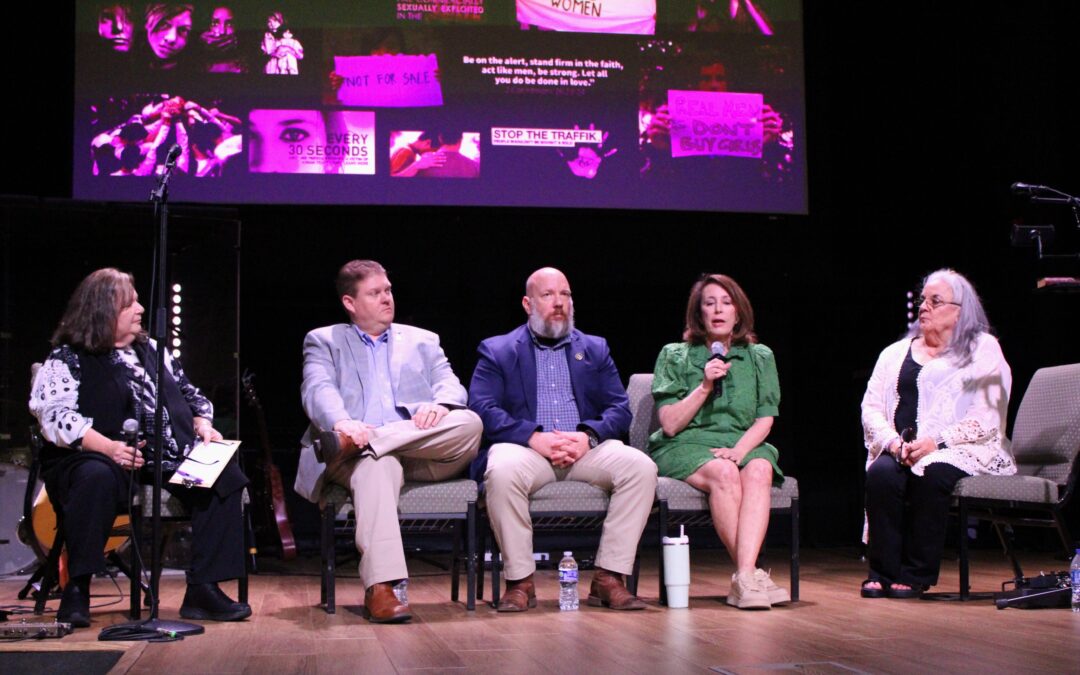
Following Maggart’s song, a panel discussion was held, with HopeUNITED Training Specialist Pam Stack moderating and Guthrie, Forensic Interview Specialist Teresa Collier, Office of the Alabama Attorney General Special Agent Bryan Goza and Alabama Law Enforcement Agency Lt. Richard Holston answering questions.
Stack asked, while people would not invite an offender or a predator into their homes to spend time with their children, how are children open to similar risks when given time online?
“When you pick them up at school, and you’re driving them home, more than likely that predator is in the backseat with your child as they’re scrolling through their phone,” Collier said. “One of the things that we talk about all the time is just how, because we live in a digital world, and our kids are practically born swiping screens, it’s like a Pandora’s Box, but a lot of parents don’t even think about things that… I love the website Thorn for Parents; I use it as a grandmother because it has resources. You can go online and they tell you how to have conversations with four or five and six year olds about online activity, and what to do if something happens — if they see something they shouldn’t see, how to deal with all of that — because it’s hard to know how to deal with that, but I just think that’s a great resource for parents.”
Reflecting on her relationship with her children, Stack asked the panel how to engage children who are not prone to discussing what is happening in their lives or sharing if they are in a dangerous situation.
“Let’s face it, children don’t tell us everything,” Holston said. “I’m not the guy that my kids come to. But let’s face it, our kids have somebody else they already talked to. So you need to let them know that whoever that is — their pastor, their youth leader, their intern at school, whoever — it’s okay to tell somebody else, as long as they tell somebody. One thing that, unfortunately, I have had to deal with is the sextortion, where some kid doesn’t know how to handle it, and he or she doesn’t have anybody, they don’t feel like there’s any way out and then you end up with someone taking their own life.”
Stacks also asked what apps parents and guardians should be concerned about regarding their children’s online safety.
“I can tell you today the apps that are being used that we see the most in our cases, but in six months from now, that list is probably going to be obsolete,” Goza said. “Some will always be there. But the main thing is understanding the safety and the parameters and the boundaries of how to use these apps, how to be safe on these apps. You definitely have apps that are 100% designed for criminal activity with people under the age of 18 — there’s no other reason for some of the functions in some of these apps. I just learned about a new one tonight, and so I would say the point is to understand what the potential safety concerns are and how to have that open communication. Some of the oldest ones who came in on sextortion cases were in their 60s and 70s — it didn’t matter. So we have to learn to unplug a little bit, and we have to learn how to survive in a digital age and not have to be digital all the time.”
Following the panel discussion, a time for audience questions and answers from the panel was held. For more information, visit Worthy2 on Facebook or www.worthy2.org.
