
Homes, shops, restaurants and offices to revive historic Pepperell Mill site
BY DANIEL SCHMIDT
THE OBSERVER
OPELIKA — For 20 years, the old Pepperell Mill site has sat vacant and overgrown. Now, the historic land that much of Opelika sprung up around has a new lease on life.
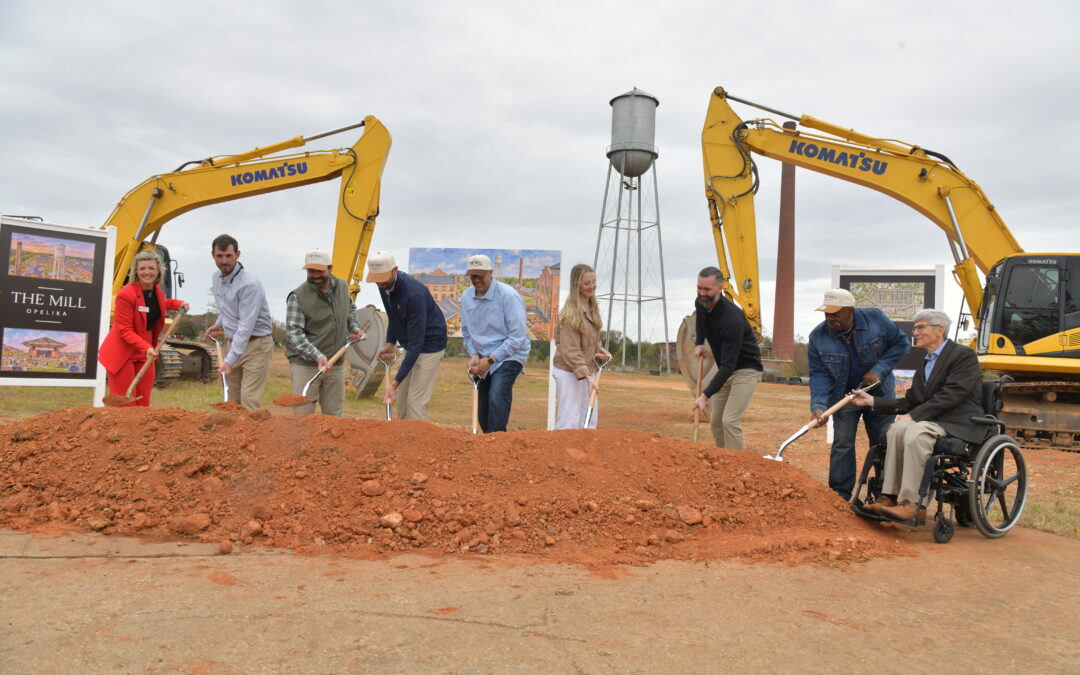
On Thursday, Nov. 19, city leaders, business owners and community members gathered in front of dozens, with shovels in hand to mark the start of its next chapter.
Holland Homes broke ground on The Mill at Opelika, a mixed-use development that will bring homes, restaurants, shops, office space and a large green space to the former mill property. The ceremony was hosted by the Opelika Chamber of Commerce.
The roughly 42-acre project is part of a broader wave of growth in Opelika. According to the project’s original scope, which the city approved in 2025, the $125 million mixed-use development will feature 327 single-family homes and luxury townhomes.
“Today is about more than turning dirt,” said Ali Rauch, president and CEO of the Opelika Chamber of Commerce. “It’s about giving this place a future worthy of its past.”
Rauch opened the ceremony with a look back at the site’s history. The Pepperell Mill opened in the 1920s and became Opelika’s largest industry. The company also built an entire village for its workers and their families, complete with a movie theater, pharmacy, grocery store, post office and barber shop.
“I would bet many of you have a parent or a grandparent or a neighbor who worked here,” Rauch said. “So for a lot of families in this community, this isn’t just a piece of land. It is where their story in Opelika started.”
Rauch noted that even after the mill closed, Pepperell Village never stopped being home for the families who still live there. For the business community, she said, the project means new neighbors, new places to gather and new opportunities for local businesses to grow.
Daniel Holland, founder and president of Holland Homes, grew emotional as he described how the project began. According to Holland, he and his wife were driving to Waverly Local on a Friday night six years ago when he looked over at the mill’s water tower at sunset and said the site would be an amazing place to redevelop.
The next morning, someone he had never met called his office asking to talk about selling the company the land.
“I knew from that moment it was something special, and it was a lot bigger than us,” Holland said, adding that it has taken more than five years of work to reach the groundbreaking.
Holland said the goal is to create more than homes and commercial space, instead hoping to create a place where people can gather to shop, eat, work and live. He described the development as a “missing middle” for Lee County, located almost directly between Opelika and Auburn and striking a balance between a downtown college atmosphere and more upscale, reservation-only dining.
Plans call for a large central green space, with parking and traffic kept to the outside so children and families feel safe. A stage and a large video screen will host entertainment, and Holland said he hopes it becomes the place where people in town come to watch away games together.
The first building to go up will be a 32,000-square-foot office and coworking center. Holland Homes will move its offices there and share the building with other companies, offering about 50 memberships that give small businesses access to resources a growing business needs.
Holland said the development will take shape in stages over the next three to five years.
Holland said one word kept coming to mind as he thought about the project: harvest, which he defined in its simplest sense as gathering together.
“This place literally was what Opelika was built around,” he said. “So it’s a true honor for us to get to see this, and look forward to building it together with y’all.”
Opelika Mayor Eddie Smith spoke about his own childhood in the mill village, where he lived at 204 24th Street. He recalled a time when children could leave home in the morning and return for supper without their parents worrying because neighbors looked out for one another.
“I see that happening again,” Smith said.
Smith said Holland first shared his vision with him and then-Mayor Gary Fuller roughly five years ago, leading to discussions about development agreements, cleanup of the brownfield site and what could be built where the mill once stood. Holland proposed putting shops and other non-residential uses on the mill footprint.
Smith also praised Holland’s plan to place driveways behind the homes rather than on the street, which addressed residents’ concerns about whether the village’s narrow streets could handle extra traffic.
“Brilliant, brilliant idea, Daniel,” Smith said. “Thank you for your investment in our community. We are tickled to death to be here today.”
The Pepperell Manufacturing Company, originally founded in Maine in 1844, was looking for a mill site in Alabama in 1924 when its representatives stopped in Opelika. To win the plant, local residents raised $62,500 and offered 300 acres of land while the city promised a five-year tax break.
Ground was broken in early 1925 on a former cotton field, and an estimated 350 people worked at the mill in 1926 making fine fabrics, cotton drills and jeans. By 1934, it employed 800 to 900 people, and unlike many mills across the country, it never shut down during the Great Depression. During World War II, the mill turned to jeans, drills and sheeting for the military, and its workforce ballooned to 1,000.
The mill village grew alongside it, starting with 100 houses and reaching about 240 by 1946. Workers rented the homes for $2 a room, and the company handled maintenance for free. The village also featured a school, a clinic, theatre, stores and a church where Baptists and Methodists took turns holding services. The company also fielded baseball and basketball teams.
Pepperell then began selling the village houses to residents in 1958, and the city annexed the village in the early 1960s. In 1965, Pepperell merged with West Point Manufacturing Co. to form West Point-Pepperell. However, the company filed for bankruptcy in the early 1990s, rebranded as WestPoint Stevens and later closed many of its U.S. plants. The Opelika mill finally shut down in 2006.
On the night of March 12, 2013, a fire swept through the mill while part of the building was being demolished. The mill and village were added to the National Register of Historic Places on March 31, 2014, as the Pepperell Mill and Mill Village Historic District.
Today, a small building, the brick smokestack and the water tower, which was added in 1975, are all that remain of the complex, while more than 100 of the original mill houses still stand. A concrete dragon plaque that once hung over the bleachery door was saved and now sits outside the Museum of East Alabama in downtown Opelika.
Before the ceremonial shovels went into the dirt, Ali Rauch thanked Holland for keeping the mill’s water tower and brick chimney standing and making them a centerpiece of the development, noting that Opelika loves its history and doesn’t like to see things torn down. She said she had worried the landmarks would someday disappear.
“This is the future,” she said, “and we are thrilled to be here with you.”
