
BY ROB DAVIS
FOR THE OBSERVER
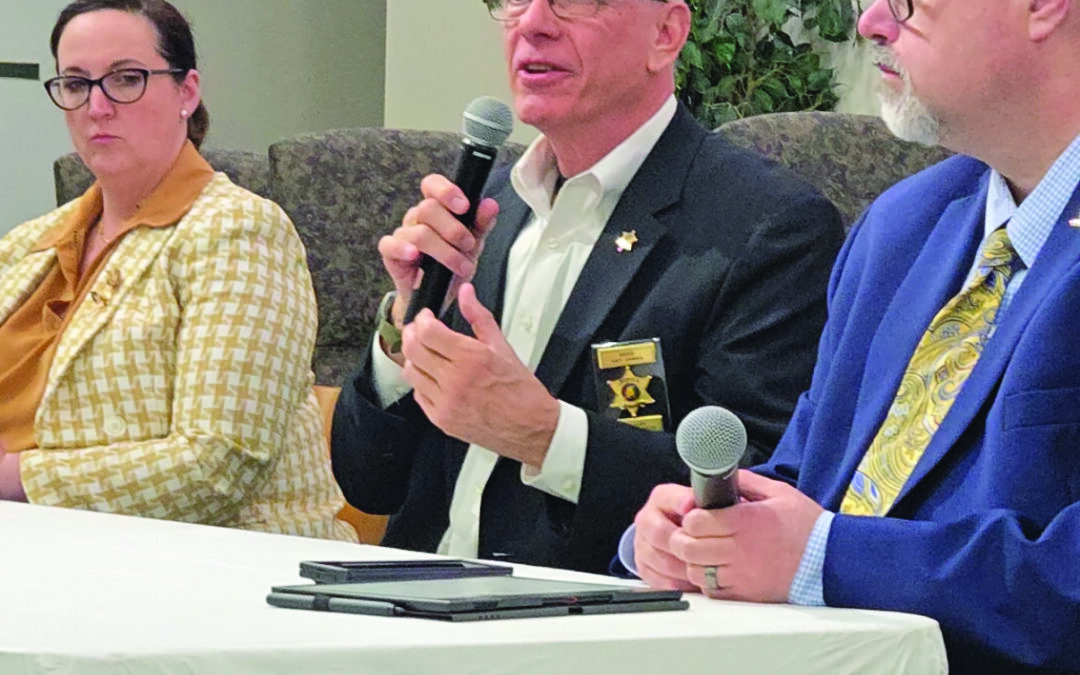
LEE COUNTY — Local law enforcement leaders met with the Lee County community Monday, March 2, to answer questions and discuss ways law enforcement and members of the community can work together to combat crime.
The event was held at Christ Temple Holiness Church in Opelika and was hosted by the NAACP Lee County Branch 5038. Laticia Smith, President of Branch 5038, moderated the town hall discussion and welcomed the panel that included Lee County Sheriff Jay Jones, Opelika Chief of Police Johnathan Clifton and Lee County District Attorney Jessica Ventiere. Auburn Chief of Police Michael Harris was invited but was unable to attend.
According to Smith, Lee County Branch 5038 believes that C.P.R. (Community. Police. Relationships.) saves lives and that local law enforcement are “partners in protection.”
“What we know to be true is that for a community to successfully and effectively combat violence we have to build and foster strong relationships of mutual trust between the police and the community,” Smith said. “Since we rely on each other it is so important that we put law enforcement in front of our community.”
The panel of law enforcement leaders all agreed that effective law enforcement begins with community trust and communication. Following introductions each panel member spoke about their departments and the importance of positive community relationships.
“In my mind, my philosophy is that it’s all about community,” Clifton said. “We work for the citizens. We are your police department. At the end of the day we work for the victim. And we can’t solve a lot of cases without the help of the community.”
Jones reflected on his time as a teacher at Southern Union and Auburn University, recalling what he would say to his Introduction to Law Enforcement students.
“One of the very first things that I would offer to the students is simply this; The primary cornerstone, the column, the main support of what we do in providing public safety is doing everything that we can to ensure that we have your support,” Jones said. “I would say to the students, ‘If you do not have the support of the people you serve, you are just wasting your time.’ It’s very simple but that’s how this all works. It’s about trust. It’s about being transparent.”
Ventiere spoke about how the murder of her grandmother shaped her personality as a prosecutor. She said the murder is still unsolved after many years and she believes it will probably never be solved. According to the District Attorney, the murder of her grandmother gives her a unique perspective when working with victims.
“That whole experience of my life has colored every single thing that I do,” Ventiere said. “I think in some ways our office is a little more aggressive when it comes to cold cases, in particular because of my family history.”
During the question and answer period of the town hall a member of the community asked Ventiere why cases seem to take such a long time to get to trial.
“We have an extreme case load here in Lee County,” she said. “The criminal justice system is slow. In the state of Alabama every felony case has to go through a grand jury first. That really slows things down but it is an important aspect of the criminal justice system.”
Ventiere also explained how mental health examinations and forensic testing delays the process.
“The department of forensic sciences has to test all of our controlled substances and they are currently 24 to 36 months from getting us a result on cocaine or methamphetamine,” Ventiere said. “There are a lot of things that delay cases and unfortunately it is a tedious system that we have.”
The panel also answered questions from the community regarding the Lee County homeless population and officer-involved shootings. Jones and Clifton both explained how officer training is essential when working with those who are homeless as well as navigating dangerous situations.
Smith closed the town hall by thanking the panel and guests while reiterating the importance of cooperation between law enforcement and the community.
