
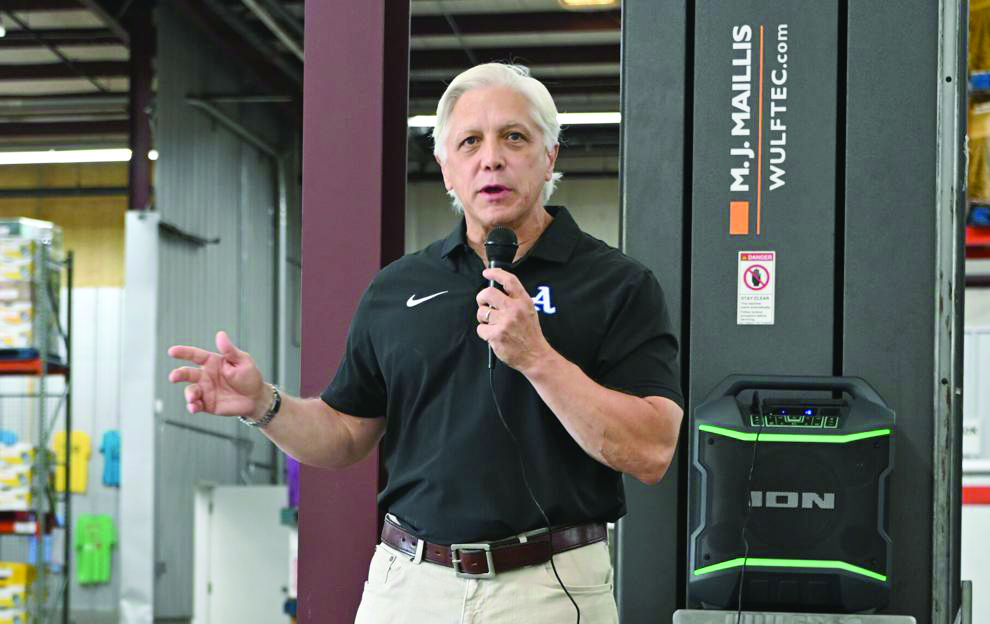
Ron Anders
Robert Wilkins

The following is a question-and answer session between Auburn Villager Editor Brian Woodham and Mayor Ron Anders. Reprinted with permission.
AUBURN VILLAGER: Auburn’s experienced a lot of growth over the last decade and a half, and some residents might not be as familiar with you as lifelong residents of Auburn. Could you provide some background information for people who might be new to town and not know much about you?
RON ANDERS: My family moved to Auburn in the mid-60s. My grandfather and my father opened a retail business called Anders Bookstore, which was a traditional college bookstore. I’ve been here more or less ever since then. After college, I moved to Birmingham for a couple years, but came back to Auburn in the late 80s, and have been here ever since.
My family had that business for over 40 years. It was a great place for me to be exposed to what makes Auburn unique. My parents allowed my brother and I to be very involved in the business, from just hanging out with them while they were working to having odd jobs there as young teenagers and college students. And then eventually I got to work there for over 20 years as an adult.
I met my wife in the early 90s at our bookstore, and we’ll be celebrating number 34 here this August. All three of our children are Auburn University graduates. Very proud of what they have become in their jobs. They are all married now, and we are the proud grandparents of three grandchildren, two girls and a boy, and we’ll be expecting our third granddaughter — our fourth grandchild — the day of the election.
But Auburn has been very, very good to me and my family. It provided a way for us to live in this community and be a part of [it]. My parents were both very involved in the community. My father served in a lot of traditional roles that people who own businesses in Auburn would serve in, whether it’s the Chamber of Commerce, coaching my brother and I on teams or being involved in their church. My mom helped start the first hospice in the county that was actually a nonprofit back in the days when those services were not provided. And so I’ve just watched their hearts as they give into this community, and so it was just really, you know, something I’ve learned as I’ve witnessed my parents, to serve.
So, I when I moved back home, I had an opportunity to be involved in the community and was very active in the community, and that has led to these opportunities here in the city that I’m very proud to be a part of, and ultimately become the mayor. My wife is a small business owner. She’s got a boutique studio for pilates in this community that she’s had for a number of years. I have one son and his wife that live here in Auburn and my other two children. My other son lives in Huntsville, and my daughter lives right now in Washington D.C.
AUBURN VILLAGER: What is your background in regards to service in the Auburn community?
RON ANDERS: I always tell the story when I’m especially around the Chamber of Commerce. There was a day when I just moved home and I was in my mid-20s. And Gail Alsobrook, who was the president of the Auburn Chamber of Commerce at the time and a sweet lady, she walked into the store one day and said, “I need to speak to you,” and I didn’t have any idea what she might want. She says, “I’d like to have someone nominate you for the board.” I said, “Well, I’m awful honored. I feel awful young.” She said, “Well, but that’s the point. You’re the only young business person in this community right now, and we need you to serve on the board.” So that got me started in a journey of being involved in different activities in the town.
And the Chamber of Commerce was certainly a great, great place for me to participate and do the good work of continuing to make Auburn better and help small businesses thrive in this community. Ultimately, I was elected chair of the Chamber of Commerce, and my father and I have the unique distinction of being the first parent and child to be the chairs of the Chamber of Commerce, and so that’s a very important organization, and I’m very proud of the work they do today.
But that led to other opportunities, whether it was through the Boys and Girls Club or through the Child Advocacy Center. I was very involved in my church as far as serving as a deacon and teaching Sunday school. When my boys played different sports, I generally was their coach in everything that they participated in. And I had a couple of unique opportunities to bring different types of things to our community. The first was the Dixie Youth World Series. In 2005, Auburn hosted the 50th Dixie Youth World Series, which most importantly gave our local children a chance to be a host team in the World Series, where they didn’t have to win their way — they got to play because of our hard work. And 20 years ago, that was a really big deal to our community. To think that today we’ve seen the most famous soccer player in the world step foot onto our field. Back in those days, when those 9-, 10-, 11- and 12-year-olds came to Auburn to play for the World Series championship that week, that was a really big deal.
And then we took that and we ended up winning an opportunity to host the Super 7, which began as a Super 6. That was a very unique project that we were asked to form a partnership with the city of Tuscaloosa and the city of Opelika, as well as the University of Alabama, and so you’ve got this whole Auburn-Alabama dynamic coming together to put a proposal in front of the Alabama High School Association that says we want to share in partnership hosting the Super 6 each year. And for about 15 years, we swapped hosting that event. I believe, at the end of the day, it was a net positive for our community. People were very proud to host that event in Auburn, and what we tried to do is with the year that the Iron Bowl would be in Tuscaloosa, that at least Auburn would get to host the Super 7. And so that brought a little bit of economy to our community in a year where the big game was not played here.
That was through partnerships. It was through the city of Auburn. It was through Auburn University. It was through the city of Opelika. It was through hundreds of volunteers. It was a big deal to host that, and I believe at the end of the contract, we had hosted it eight times, and it was a lot of fun and very enjoyable. All of those community service and civic service opportunities again, along with being in a small family retail business, paved the way to take the next step to being an elected official in the state.
AUBURN VILLAGER: What prompted you to seek a third term as mayor and what do you hope to accomplish if elected for four more years?
RON ANDERS: I just feel like the opportunities are still right there in front of us, and there are some personal goals that I would like to see our community get to the finish line on. We’ve got a lot of momentum right now, and I believe there’s a chance for our city council, for many of us that have been working together over the last four to eight years, to stay in place. Five of those city council members have already been certified and reelected. I believe everything is in place for us to continue to have momentum to make great decisions on behalf of our citizens.
When I think about things that are important to me — getting a South precinct built for our police officers, so on the southern part of our community they can get to where they need to get to quicker, and they can also remind those that maybe don’t have our best intentions in mind that they’re there, and we’re available and we’re watching. So I just believe, ultimately to protect our community at the kind of level that we all want to see us be protected by, that having that facility for our police officers is key to the future public safety of our community.
Our citizens have asked us to put a put a heightened focus on our road network. Obviously, the growth that has come from our city and our university has created times where it’s a little more difficult and it takes a little longer to get to where you want to go in our community. And so we have allocated a sizable amount of resources, citizen resources, to working on our road network and our intersection network over the next five years. And I’m committed to making that happen. Those are trying projects because when you go and redo an intersection, redo a road, there’s always orange cones, and there’s always delays that you’ve got to work through. But by and large, ultimately, those are the right things for us to do.
Additionally, there’s some parks and rec projects, particularly the Richland Road project, getting Richland Road started as a location for parks and rec amenities in our future. North Auburn has needed some of those amenities, and so the first project we’re looking at on Richland Road is a youth baseball and softball complex. Our ladies who play softball have been kind of hopped, skipped and jumped over in our community over the timeline of girls softball being offered, and now it’s time for them to have an identifiable complex that they can call the Auburn Softball Complex.
In addition, we need some more room for youth baseball due to the growth in our community, and so that will be the kickoff of the first project on Richland Road. You’ll see there’s a master plan. Ultimately, most anything you could think of that involves parks and rec will probably end up in and around Richland Park. We believe that’s going to be a tremendous asset to all of Auburn, particularly the north part of Auburn. There’s also a pond there that allows us to think cleverly about how we want to utilize that. And so, those three things from just getting-things-done-in-a-project standpoint.
I think the continuation of our partnership with Auburn University is key and critical, and it opens the doors for opportunities that are great for our community. And the research park is certainly an entity that has been built in partnership with the city of Auburn that I believe we’re still scratching the surface of what it can really mean to our community. The new RFID building is a great example of the city and the university — the Industrial Development Board and the Research Park Board — coming together and thinking of clever ways and the best ways to create opportunities and to create capacity in this community in alignment with the university, and I’m excited about what that relationship is going to be in the future.
I’m also excited to continue to work with East Alabama Health and continue to expand their footprint in our community and making health care more accessible to those that live in Auburn. Having the freestanding emergency room on campus on the north side of town has been critical, and I believe there’s many, many of our citizens that would say they’re thankful that that facility was there when they needed it. So the expansion of East Alabama’s footprint in our community and what they continue can continue to mean to our citizens that have tremendous needs — when you have a health need, that’s sometimes a pretty serious need — it’s something I want to continue to work on as well.
AUBURN VILLAGER: Stretching all the way back to when the city began conducting a citizen survey, traffic flow and infrastructure have basically been the top two priorities identified by citizens as what they want addressed, and today those are still the top two priorities. How do we do enough to address those concerns? What needs to happen to get us to that next step?
RON ANDERS: Look, heads and beds always come before the road improvements. It’s just the natural progression of a community. We have been committed. I mean, if you look at all of our budgets and you look at all of our projects, we have done something every year. We have committed sizable community resources to certain road intersection projects every year. We have certainly taken the idea that you cannot eat the elephant all in one meal. You’ve got to stay on top of it. That’s why we pave a few roads every year.
But the time has come now due to the growth of the community and the university. I think it’s important to recognize that, since 2018, 40 percent of the growth that has happened in Auburn has been Auburn University growth, and that’s exciting. That means that what people see in Auburn, the city of Auburn, they’re seeing in some manner in Auburn University, and I believe those are good signals that our community’s on the right track when people want to be here. So we’ve just got to continue to work at that, and we have consultants that help us make those decisions as to where the most critical needs are, and we certainly listen to our citizens about where they think the most critical needs are. But I believe in a growing community, there’s always going to be a need for traffic infrastructure improvements. That’s just that’s just how cities work.
But are we going to more aggressively approach that over the next five to six years? Absolutely, I mean, if you look in our CIP (Capital Improvement Plan) we’re looking at about $150 million between now and 2030 that we’re committing to road improvement projects, which include intersections. So our citizens have my commitment that we’re going to stay after this, and we’re going to stay acutely on top of it. That’s never going to mean that there’s not going to be times at 5 o’clock in the afternoon or 7:45 in the morning, when you’ve got to be thoughtful about where you’re going and how you’re going to get there, and how much time do you have to get there. That’s just the nature of a growing community, but we’re working on it.
Ultimately, there’s a big project called the Outer Loop, which has been talked about for a long time that, more or less, builds a release valve that goes from 280 to I-85, and that’s a major project. It’s going to cost a lot of money, and we’re going to go ahead and start planning for it right now. We want to make that project shovel ready, so when we do receive the money that we need to build that project, we’re ready to go.
I believe the extension of Yarborough Farms Boulevard is going to be a big help to those people who live on the north side of town, to give another road that runs parallel to Shug Jordan Parkway, runs parallel to Farmville, that goes from right there where the AU Club entrance is past the new high school all the way over to the Cary Creek entryway. I believe that this can be a tremendous help to our community for those people in North Auburn.
I would also say this in a related topic. When you think about the projects that have been approved recently, whether it’s the new Kroger shopping center project or the Foundry, there’s one line of thought where people could believe that that’s just going to add more traffic. We believe that it’s going to lessen traffic because the people who live on the north side of our community, who get in the car to make most of their daily trips to wherever they’re going, that once these projects are built out, they’re going to find a lot of those daily needs, including where their children might be going to school, are going to be close by. And so they’re not going to have to leave a neighborhood that’s off Farmville Road or off Donahue and travel all the way to the southern side of our community to just go to basic entities to serve their needs. They’re probably more than likely going to find all of that right there.
So whether it’s a place that they want to have a meal, whether they need to go to the bank or the cleaners or the vet or the doctor or the dentist or buy new shoes for their children to go back to school, there’s a great opportunity for all that to be right there in front of them — plus grocery stores — and keep them from getting out on the main roads and being caught up in additional traffic. And so we’re really hopeful it’s going to be a help. But it’s going to be a tremendous asset to traffic challenges in our community; it’s not going to create more.
AUBURN VILLAGER: : Elsewhere in the latest Citizen Survey, residents expressed the most dissatisfaction with city leadership in the level of public involvement in decision-making and transparency of city government. How do you address those concerns?
RON ANDERS: When I became the mayor, we made a conscious decision to really change the way our city council meetings work. And we offer a number of opportunities for people to speak during city council meetings, whether they’re speaking during a public hearing, whether they’re speaking about things that are on the agenda at that point in our meeting or they’re speaking at the end as far as citizens’ communications. We also made the decision to broadcast our meetings on radio as well as stream them through our streaming services, and they’re all archived where you could go back and watch them at any point in time. We changed the way our boards and commissions work to allow people to apply for those positions, and then for the two boards and commissions that we felt like were elevated, we created an interview process for people to be selected to go through interview processes. Ultimately, for boards and commissions, the council has to select a person to serve in those roles, and those are a lot of times very difficult decisions to make.
I believe when I see our city council members, and I know what comes before me, and citizens reach out to us to ask questions or to express concerns, I watch us, what I believe, be very responsive. That doesn’t mean that if you’ve got a pothole up the street that it gets fixed the next day. But as far as elected officials responding to those folks that they represent, I believe by and large our city council has done a great job of that. And I’m not saying we’re perfect. With the volume of calls and communications we get, invariably somebody’s going to forget to call somebody back or forget to return an email. But I watch and I listen to our council members and how they’re responding to their constituents and working through the staff here at the city of Auburn, primarily the city manager, to get things addressed. And I believe that we’re doing as good a job as we can possibly do.
All of our meetings are, when we pass our budget, that’s all presented to our community. They have time to evaluate our budget before we conduct any types of hearings or meetings about that. All of those meetings are very public, and you know we thoroughly pass a budget after what we believe is plenty of time for people to consume the information and understand the decisions that we’re making. I believe leaders and cities can always improve, and we can always get better at those kinds of things. But I believe without question that we have taken significant steps to make our city government as available to our citizens as possible.
AUBURN VILLAGER: One of the bigger recent citizen-involvement projects is Auburn 2040. The community came together in the fall of 2024 to work on the project. Where does the process stand and why the delay in a final product?
RON ANDERS: Well, the city manager and the staff have a draft, and this was brought up at a recent council meeting. It’s our desire that this is going to be approved by this council before their term is out, so the last council meeting for this term would be the second meeting in October, and it’s our desire to get it approved then. It’s just a lot of information. It’s a lot of decisions. It’s trying to cull down all the talking points and all the things that were discussed into some tangible goals that the city can put into play over the next 14 years. It just takes time and thought. We don’t want to be reckless about this. I’m on the record at a council meeting as saying that we’re going to get this done by the time the term of this council is over with. So, I guess technically that’s Oct. 31.
If it’s going to be useful to your community, you want it to make sense for our community, and there’s just a lot of information. And look, we had a tremendous outpouring of support from our community, and we’re certainly thankful for that. It’s a shame we had a lot of momentum, and then the pandemic hit. Hopefully, you know, in a perfect world, this would have been done and dealt with by now. But it just didn’t work out that way. And trying to get the train back on the tracks, it was just challenging.
AUBURN VILLAGER:The recruitment and construction of data centers is at the forefront of many communities’ economic development right now. Where do you stand on the issue as it pertains to Auburn?
RON ANDERS: We have a couple of data centers in this community. I would say, based on what we are hearing and seeing that is being built across the country, I would call them smaller data centers. We are fine with that number right now, and we are not trying attempting to engage any other data center companies to come into our community. We’re blessed that in the city of Auburn we have a lot of momentum with our industrial recruitment. We have had a strong summer of announcements of companies that are either coming to Auburn or expanding in Auburn. We just announced one last week at the air show, and that’s where we are really hanging our hat as far as industrial recruitment is with those companies that, particularly in the automobile and air sector. That along with the potential of the research park, really gives us plenty to work on and a lot of opportunities, and that’s where we’re going to focus our time.
AUBURN VILLAGER: You’re closing in on the end of your second term in office. What has been the most challenging or surprising aspect of serving as mayor over the last eight years?
RON ANDERS: When I look back on the first eight years, the first term was very challenging. One can think that they are ready for something, but until you sit in the chair and have to do the job — that’s the best experience you’re ever going to get. And so in my first term, 2018 and 2019 were just extremely challenging. My wife and I, both of us lost a parent. Auburn lost a police officer for the first time in history. We lost the voice of Auburn in a tragic automobile accident, and then COVID-19 hit. That was just a tremendous, tremendous challenge to attempt to lead through a situation that really no one was prepared for. The rules of trying to deal with that, the policies were forever changing. It was controversial.
People, there was a lot of anxiety, and it was hard to do business. It was hard to manage and lead a city when you can’t get together and talk, when you’re having your meetings through Zoom and making critical decisions on behalf of your community. It was just a very, very challenging time.
And when I look back over my first two terms here in the city, that first term was very challenging and the COVID part was the most challenging. Losing Will Buechner was also another situation that Auburn had never experienced before, and it was certainly not something I ever thought that I would be dealing with as mayor of Auburn. But I’m very proud how we have recognized Officer Buechner by naming a road for him, a critical road that we need as a community, but recognizing his value and his sacrifice to Auburn forever, permanently naming that road for him.
AUBURN VILLAGER: What is your pitch to the Auburn community for why you should be reelected to a third term?
RON ANDERS: I believe that if you look at what we’ve gotten done last eight years, including some very challenging times for a couple of years in my first term, there is a resume of progress. We were very challenged by our inventory of parks and rec facilities. And we have shored that up and been very aggressive, if you look at our soccer complex, if you look at Lake Wilmore, if you look at the ball fields at Lake Wilmore. One of the projects I’m most proud of is the Town Creek Inclusive Playground.
If you look at bringing the beginnings of a hospital to our city, onto campus; if you look at what has happened with our industrial recruitment and the kind of companies now that are providing jobs for our community; if you look at the relationship with the city of Auburn and Auburn University and what we have continued to work on together, I believe people can see that we have been doing the very best we can for them.
I still am very bullish on the fact that Auburn has bright and wonderful days in the future, and I hope by the work and the efforts and the commitment that they’ve seen out of me over eight years that they will allow me to continue to lead this community for another four years.
The following is a question-and answer session between Auburn Villager Editor Brian Woodham and mayoral candidate Robert Wilkins. Reprinted with permission.
AUBURN VILLAGER: Just in general, tell me a little about yourself.
ROBERT WILKINS: Well, I wasn’t born in the United States. I was born in Germany. My mom was born in Austria, so I’m a naturalized citizen. Didn’t know for many years that I wasn’t, so I actually got naturalized in ‘88 in Mobile. But I came over here a week before I turned 6 with two of my half-brothers and my first adopted father, and my mother was not able to come over for whatever reasons, and then within a year and a half, I ended up in a children’s home in Selma, Alabama, a Methodist children’s home in Selma. And it was the type of place where they had like 10 houses, they had all kind of amenities. They had a pool, tennis courts, and this was back in the ‘60s.
But then at age 10, I was adopted for the second time in West Alabama between Tuscaloosa and the Mississippi lines, Pickens [County]. And I grew up on a farm, and I got to do something that was different from most people — social services came to me and asked me what kind of parents I would like, and I said “I’d like to have parents that live in a rural area on a farm.” So that’s what I ended up. And I wanted an older brother, and that’s what I got. I even got to pick my middle name within a year, and I originally wanted this name Garland, but anyway, ended up being my mother’s maiden name because I thought the family accepted me so much. So then I went to college at Alabama and Auburn, so I’m kind of a mixed breed.
I’ve started or been a part of 14 different companies. They were all in different fields, so I’ve done a lot of stuff in the business world. My wife is from Auburn and we’ve been here 11 years, but her father was a professor at Auburn, electrical engineering professor, and then her mother was a home economics teacher for years at Notasulga.
AUBURN VILLAGER: You’ve been getting up to regularly speak at city council meetings since the short-term rental ordinance was being debated and discussed. Did that ordinance serve as the spark to get you to speak up publicly?
ROBERT WILKINS:: Yeah, it’s unfortunate that too many of us get involved for a personal reason, and that was the short-term rental because I was doing it. My wife has MS, and she was beginning to have some difficulties, so I didn’t need to … I had people that wanted me to work for them, or partner with them, and I didn’t want to do that because I needed to be here more often. So yeah, I did that, and at every council meeting I was there talking about short term. It was hard to come up with a lot of different angles, but I worked hard at my speeches.
But as time went along, I realized there were more issues than my personal issue, and so I began to see a lot of things, so I began to speak up on everything — not everything, but things that I thought were important.
And then I realized as I talked to people, and they were afraid to speak at council meetings. So we would talk about issues, and I’d actually go and talk about those issues that they didn’t want to bring up. And I was shocked at a small community, which it is not anymore, it’s a small town, but that people were afraid to speak up because they thought their parents or their uncles and aunts might get a repercussion, which was kind of hard, and still has been hard to understand because it seems like such a wonderful community and has so many amenities and so many good people in the city. But so I got more and more involved, but still, I had no intention of running for mayor. That was the last thing.
AUBURN VILLAGER: What prompted you to finally take that step and run for mayor?
ROBERT WILKINS: I would like to have, but I wasn’t going to run because of my wife. Her condition was getting worse. But my wife had an epiphany, and she said, “Robbie, I need to talk to you.” I says, “Oh, I’m in trouble.” And she says, “I need to talk to you about running for mayor.” I said, “I just can’t do that because of your condition.” She says, “No.” She says, “You have to run for mayor because your energy and the excitement and the things that you do every day.” Because I talk to everybody, and I still do Uber Eats because that was kind of a spinoff from the Airbnb. And I’ve met thousands of people, had a lot of great conversations.
And my wife says, “You just have to run.” I said, “Well, I want to run, but I just didn’t think that would be wise.” So, I actually asked her every day for like 30 days. I said, “You sure? You sure?” before I told anybody, and she said, “Yeah, yeah.” And I told her, I said, “Well, once I put my hat in the ring, you know me, I don’t stop.” She says, “You got to.” I said, “Okay.”
So I did, and I’m excited. I’m enthusiastic. I think Auburn. You know, I’ve never been in a position where there’s so many good things about something. I’ve started businesses where we had great ideas, but there were so many things that were difficult to manage. In Auburn, my goodness, look what we have! We have an incredible amount of resources of people. Just that alone is great. But then we have revenue galore.
I mean, we have 36 funds. You know, some of those are required by the state and the federal government, but a lot of them are not. They have funds for expenses. They have all these different funds, and I’m like nobody gets to do that. I’ve been in cities. I’ve lived in Mobile. I’ve lived in Montgomery. I’ve lived in Tuscaloosa. I’ve lived in the Virgin Islands and St. Thomas. No one ever had the resources that Auburn has, and I just think it needs a little tweaking.
AUBURN VILLAGER: Have you ever held public office before?
ROBERT WILKINS: No, I have not. I have helped run statewide campaigns before, but I have never run myself. My original goal, being a naturalized citizen, I knew I could never be president, and that’s kind of the way I used to be as a kid. But I realized the best I could be, I remember, was Henry Kissinger when he was secretary of state. But I always wanted to be governor.
But when I got involved in the political aspect when I lived in Montgomery for five years, I just didn’t … Your personality had to change in order to adjust, and I said, “Nah, it’s not my cup of tea, so I just pulled away from it totally.
And here, it was just out of necessity, I guess. I just felt like I have enough experience in so many different things. I’ve dealt with foundations. I’ve dealt with a lot of nonprofit groups through the years. I’ve helped a lot with youth groups.
In Montgomery alone, at one time I was the president of the Hugh O’Brian Youth Foundation, president of Montgomery Riverboat Commission, external vice president of the Montgomery Jaycees. So I like to be involved, and that’s probably my weakness is that if there’s a cause, I want to be involved.
AUBURN VILLAGER: You’re running on a platform of “Citizens First.” Can you explain to me what that is and what that looks like in practice?
ROBERT WILKINS: Well, I believe that when you look at the graph diagram they put in the financial statements. It’s got citizens, it’s got the council and then it has the city manager, and then all the departments under her. Okay, I feel like that’s been kind of reversed. Our city manager seems to be pretty much in control. The council, yes, they make the ultimate decision, but there’s too many things that are decided before it gets in there, and the citizens are third. So I want citizens on top. I want them back there.
I want every time that something comes up, my mind will be based on: Is this good for the citizens? Is this — first, will it make the citizens, you know, their lives easier and better? I’m a servant of the people, and I know once I get in there, I can’t be like I’ve been in the past. I’ll still be vocal, but I’ll be vocal for them. I believe that citizens have so many things that we can do, and I believe that as citizens first, I can do that. So every time I make a decision, it’ll be based on that.
AUBURN VILLAGER: The Council is a representative body, so the citizens choose the representatives to speak on their behalf. How would Citizens First differ from the elections we have now? Or do you want to see us scrap the council-manager form of government and go to a strong mayor-council form, which the city of Opelika has? Where does the rubber meet the road, so to speak?
ROBERT WILKINS: Well, I think the strength of the council, participation-wise, does have to change some, and it may be a little bit like Opelika. I think the mayor, the problem with in ‘82 when they started switching it and doing two and two and two was that the weakness was actually the council. Okay, the mayor had all the control, and then the manager didn’t have any kind of control, and it wasn’t managed well. They had a lot of issues. So when they went to the idea of the council-manager, it was actually a good decision.
But what’s happened over time, the same issue is now as it was then, is the council does not take their role seriously enough. They are busy doing their, you know, that some have kids, some are retired, some are whatever, but they don’t realize the importance of every decision they make. They have to not just read those packets, but they have to question it way before they question it. But very seldom. If it’s questioned, it’s like one question instead of delving into it.
And I think that’s something that I didn’t expect you to ask me that question, but it’s an incredible question because I have really thought hard and long about it. Because I said, you know, do we go back to what we were before? Because that sure didn’t work. I mean, of course, you’ve got Birmingham, Mobile, Huntsville. I think there’s five cities in the state that have the same system we have. Tuskegee is our closest one. But I think the idea of a stronger manager type compared to the old system was good. I just think we’re allowing someone who’s not been picked by the people to run everything and to manage it, and instead we just sit back and make the decisions.
And I think that something we discussed a minute ago was the amount of people that are running. I think they’ve lost interest, and seem like people when they lose interest, they just don’t vote. You know, it’s happened nationwide. It’s happened statewide. I mean, for us to have the runoff, the primaries at 6.4 % is horrible. I mean, that’s just that’s saying you know nearly 95 % of the people are not voting, or 94 %. We’ve got to get more excitement in there, and that’s one of the things I plan to do.
We will do a task force, but everything’s set up, and they hate the word. I know you’ve heard it in the meetings, bureaucrats, and what I mean by that is the philosophy. It’s not the people. I will compare these to the employees that the city has, I think they’ve done an excellent job. I’ve never had any problems with them. I’ve been shocked that I haven’t. I’ve had other issues. I mean, like our fire department is probably the best in the country. I think we have a good police department. I think we have sanitation. Every issue I’ve dealt with, I’ve had good things.
AUBURN VILLAGER: I’m seeing a possible contradiction there. It seems like you’re criticizing the management form, that so much power is given to the city manager, at the same time as you’re complimenting how it’s being managed.
ROBERT WILKINS: It’s not the people; it’s the way it’s done. If you ask for information — I’ve done a lot of public records requests. I got, and I get what they want me to have. That’s not the way it works. If it deals with numbers and it doesn’t deal with personal information and stuff, I as a citizen should get that and I shouldn’t have to wait for a long period of time. But that problem exists on the county level. They’ve had problems getting public records, even at the sheriff’s office. For some reason, when people get in and they start staying in office, they seem to think that’s all their stuff, and they make the decision that is not theirs. When I get in and somebody wants some information, I’m going to make sure they get that information. We can’t get things to see where things are going.
But the quality of people that are in place, I think are great. But there’s a lot of tweaking. There’s a lot of problems of not being able to get that information. You know, as a citizen, if someone wants information, why would you hold back on it? Why would you wait for the whole length of time that you’re legally allowed, and then you come up with another excuse, and then you’re told, ‘Here, we’re giving you all the stuff you requested.’ Well, that’s not what I requested, but they say it is. Well, why would someone have that power? Our city manager seems to have that power, and then the council backs that person up. And it’s nothing against the city manager. It’s just the system.
We’ve created this system where we can’t get the information, and people they want to be on — we’ve got 22 boards and a commission. Okay, on those boards, so many of them are the same name families through the decades. There are a few that are just like me, people that just came, or people who’ve been here but want to be a part of it.
But too much of the decisions of each board is made by people who … you know, we have the greatest talent that there is, and why are we not pulling them and putting them in into the positions? I don’t understand. Or we’ll take someone that’s been in the same kind of profession forever, and I mean, we’ve got someone on the … We have two people. One that didn’t even have any opposition. That’s going to make it her fourth term. Okay. We have another person that probably is going to get in, and have his fourth term. Before then, he was police chief. He was a policeman. I don’t understand why we have to have the same people for a lifetime. And that’s when you have difficulties. People have that bureaucratic shield that’s created.
You want new ideas. I’m hoping in four years I can correct all the issues. Okay, probably can’t all of it, but enough. If it has to go eight (years), you’re going to have to knock me in the head because I believe in term limits. I don’t like people being in office for a long period of time. I just think it’s a mistake and most of the time, it never is a good thing.
AUBURN VILLAGER: The mayor in Auburn is essentially a figurehead, so how would you go about marshalling the political will of your fellow council members to affect change and address the problems you mentioned?
ROBERT WILKINS: As strong as I was on the end of giving my opinion, I’m also a good diplomat. I understand how to work with people. I also understand you still have the power of the pulpit, and that’s going to allow me to do things. I believe, first of all, we’ve had task forces. All have been inefficient because they were bureaucratic task forces. I’m going to have many, many task forces. I’m going to have more task forces than has probably been since the inception of the word in Auburn, and the reason is when an issue comes up, a task force will be developed, and it’ll be the people who believe in it. Like I believe in short-term rental.
AUBURN VILLAGER: The mayor and council members are surveyed as part of the budgeting process and asked to rank their priorities for issues like public safety and education or for more specific issues like the widening of North Donahue Drive. What issues are the highest priority in your opinion?
ROBERT WILKINS: I would say things that are usually not brought up, things like people who are homeless. We are a city that seems to think that if there’s an issue that we can’t discuss it in an open forum. Okay, we have homelessness, but we say that we don’t have an issue with that. We have things like we’re doing a lot of recreational stuff for youth, which I’m 100 % for having with kids, but we don’t do enough for the older adults. Opelika does, but Auburn doesn’t. So, and it’s because of getting out in the community. All these things come up, and then you start researching. You start talking to organizations that do the different things, and why they’re doing good, and we’re not as much. It’s those little things that don’t seem important as an overall thing, you know. Those big things.
Also, when we go out in the community, we do these surveys. I think they should be done verbally. I think each ward should have the mayor come in and city manager and talk about what’s going on. When I say citizens, we go to the citizens. The citizens don’t feel comfortable coming into the city hall or to talk about the issues. We need to go to them more.
So there’s so many things that a survey cannot do. And it’s nice; it’s always efficient. And that’s what I mean about this bureaucratic thing. We don’t listen to the people. We just do it the way we want to, and you have to respond in our way, and I just think direct contact. We only have one council member now that does it every few months, and that’s Connie (Taylor), and then Beth (Witten) does it online, and none of the other council members do anything in their wards because they think there’s not that many issues. Well, there’s a lot of issues. People just don’t want to speak about them. So you have to go in the community and you have to say, what do you need?
What we need as a mayor is someone who will lead the whole team and continue to improve all areas, all areas of weaknesses and all areas of strength. Because even when you’re strong in something, you can improve. And somehow the city, they’re like, “well, you’re going against a great city.” I’m not denying the city. We need improvements, and we’ve got to quit saying there’s no issues.
AUBURN VILLAGER: What are those issues you would like to address if elected mayor?
ROBERT WILKINS: Well, the first issue will be downtown. It’ll be the growth. I’ve got something a young lady said on the second of June, and I loved what she said. This was part of her thing. She said, “Growth is best when guided by a clean vision.” Our vision is grow, grow, grow. Our industrial people say grow, grow. We give them all kind of incentives. They say we can’t get them here unless we give incentives. Unfortunately, they’re right, but we leave out our small businesses. If they’re going to get incentives, our small businesses get incentives. I don’t want either one of them to get incentives because I believe in the free enterprise system. But if it has to be that way, then both sides. You know, we help a couple small businesses, so we pick and choose our winners and losers. I don’t want that anymore.
The growth. We say we got 44. We got 120 people. How many of those are from Auburn? How many did we hire from Auburn? I want to know those kind of things. I want to understand it. I want to know how many came from out of the state? How many came from out of the country? I mean, are we just importing people, or are most of them from Auburn? I don’t think so. But those kinds of things you can’t find out.
You know, it’s just a growth-growth pattern. Well, guess what happens? We lack one thing: infrastructure. Our infrastructure is horrible now, getting worse and worse. And we’re saying, “Well, we’ll do a moratorium downtown.” And I was kind of for it, but I decided it didn’t matter because we brought in two big projects, which we never had more than two working at one time, and that’s going to overload it. It’s on Glenn. I mean, what were we thinking if we’re going to do a real moratorium? We shouldn’t have a moratorium. And I’ve had a lot of developers say, Robert, moratoriums don’t work. Well, then what does work? Infrastructure. We need real infrastructure. And what are we going to do? We’re going to let the year pass, maybe even extend it at six months, and then we’re just going to let it go, and then we’re going to have the problem somewhere down the road.
AUBURN VILLAGER: Do you have any ideas about how you would go about addressing traffic flow and infrastructure, especially in a downtown corridor that’s limited or constrained by the university and a lack of north-south arterial roads and the ability to expand those. How do you go about addressing those issues?
ROBERT WILKINS: That is something that I don’t have all the answers for it. I know one thing is when I said we have talent, we have a university there. Okay, we have a university and other universities in smaller towns throughout this country — we have to do our research. One of the things that I complained a lot about is you’re not doing your research, you’re making decisions. The idea of having just our staff people research is wrong. That’s why you need a task force that will bring in the university, other universities — how do they handle those? Because we’re not the only city in the country that has this issue, and we’re not the only college town in this country.
And we have engineers, and we have a great engineering school, and even some of our competitive universities have engineering schools that are really good. It has to be. It’s a big issue. I mean, it’s not something that I can solve. I’m just Robert. But I know if you bring enough people together and you sit down and you quit doing that bureaucratic type of philosophy and just talk one-on-one, two-on-two, a group, and talk about an issue the it is so much easier to resolve.
You want somebody who’s motivated to find out. You don’t want to say, “Well, here’s the problem. How we’re going to solve it? Well, we’ll throw it over to the city.” Well, the city doesn’t have to resolve everything. We as citizens have some responsibility, and we’ve allowed that to happen. But to have an answer, oh man, this is a tough thing. I don’t know how to solve it.
AUBURN VILLAGER: Why should residents vote for you in August’s election over your opponent?
ROBERT WILKINS: Well, I haven’t been in government for a long period of time, and also I believe citizens are first. That’s the reason. It’s such a simple two words, but it’s a difficult task to put there. Also, I have a varied experience, so I learn quick, I adapt quick. I don’t have the answers. I have some solutions probably. I’m good at combining people who disagree, but I will be in an environment where I can do that. I’ve not been in that environment in Auburn, and I’m going to attack issues that are ignored, and some of them are big issues, some are small.
AUBURN VILLAGER: Is there anything else you would like to add?
ROBERT WILKINS: I noticed every person that ran with all these elections … they use the word transparency, and I like transparency. But everybody uses it, and I’m not sure they understand what it means. So I actually had talked to a professor of law, and I said “I want a better word than transparency,” and he says, “What about illuminate?” And I said, “I don’t know. It sounds, you know, professorish.” I said, “But illuminate,” I said, “Yeah.” Because if we get transparency, but if it’s so much, we’ve got to illuminate that area that’s a problem. Because that’s what you’re doing. You’ve got a lot of data, and how do you decipher through that data to figure out which is the problem? So I would say that I want to be able to illuminate areas and get people behind it and be comfortable.
I want the council members to feel comfortable with me. I know them all personally and privately, and they feel comfortable with me. They feel like I’ve been too strong at times, and there’s a purpose for that. But at the same time, I appreciate anybody who dedicates their time, and that’s what I want to do. I want to dedicate four years, not eight years, not 12 years. I just want to do four. Let’s see what we can do in four years. And I want the citizens to come to me at all times. They’re all not going to like me, but I will do what I can do and I will explain why. I won’t brush people off. I won’t ignore them because every person is a citizen that I don’t have my job without it, and my job is to be a servant of the people.
