
BY DANIEL SCHMIDT
THE OBSERVER
OPELIKA — Updates on a proposed 250,000-square-foot middle school and the Fox Run School expansion headlined the work session held before the Opelika City Council’s July 7 meeting.
Representatives from Scout Program Management, the firm overseeing the district’s capital improvement projects, walked council members through renderings, timelines and the traffic and financing questions that come with projects of this scale.
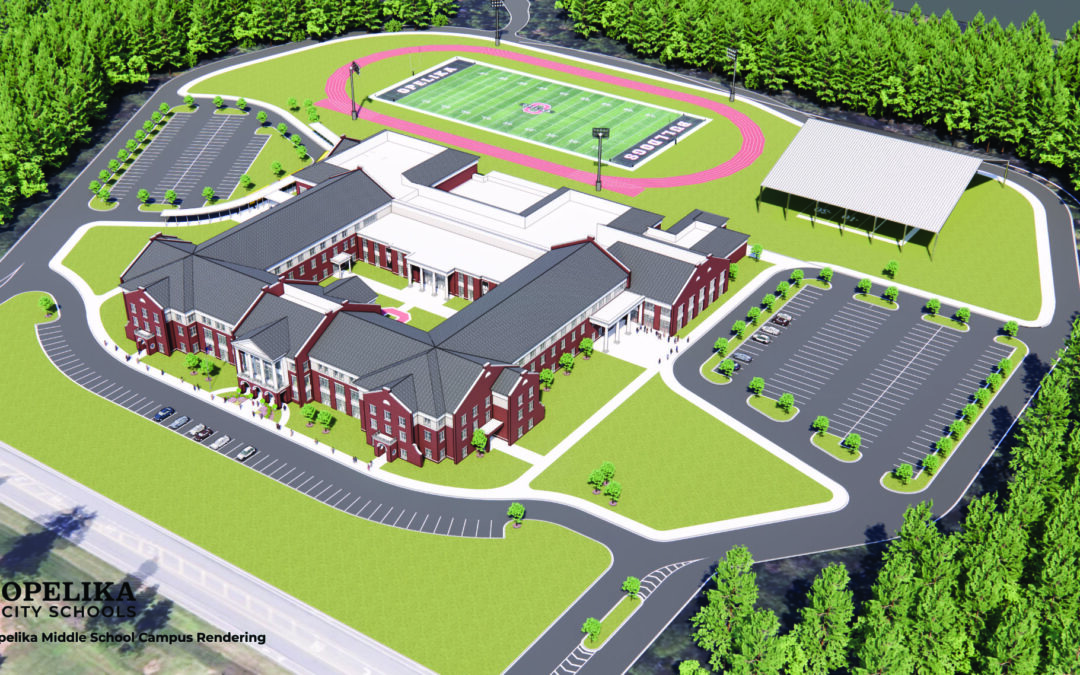
The centerpiece is a three-story middle school with 102 classrooms, built on roughly 38 acres the district already owns directly across from the Opelika SportsPlex.
Designed to house up to 1,800 students, the middle school will carry a total cost of about $140 million, a figure that includes soft costs such as furniture and technology along with contingency funds to cover unforeseen circumstances.
District officials said they expect the building to open in time for the 2029-30 school year, though no contractor has been selected yet to build the facility.
As presented, the new school would rise three stories, with each floor dedicated to sixth-, seventh- or eighth-grade students.
Renderings shown to the council depicted a campus with a football field ringed by a six-lane track, a slight downgrade from the originally proposed eight-lane track.
Other athletic facilities include a proposed 30-to-40-yard covered practice field and a basketball gymnasium with seating for about 1,500 people, which is several hundred seats more than the current high school gym.
That additional seating would give Opelika High School the ability to host larger high school games at the middle school gym when needed.
The design also includes roughly 2,000 bleacher seats on the back side of the building so the campus can stage middle school football, soccer and track events on its own.
Housing those facilities on site means younger athletes would no longer need to be bused to the high school to compete, according to Opelika City Schools and project management officials.
Because the campus sits directly across from the Opelika SportsPlex, traffic dominated much of the council’s discussion.
Officials said car, bus and pedestrian traffic from the school, combined with SportsPlex activity, prompted a recent coordination meeting with the mayor, other city officials and city employees.
The site is designed with two entrances, and the city plans to conduct a broader traffic study to determine whether a signal is warranted at one of them. A roundabout is also planned along the adjoining Andrews Road as part of a SportsPlex Parkway extension, which officials hope will keep traffic moving.
Speed limits along the parkway would drop once the school opens, most likely into the 20-to-25 mile-per-hour range the city’s school zones typically use, and planners said pedestrian crossings will be needed for students moving between the middle school and the SportsPlex during the day.
Sustaining growth
The building program is being driven by fast-rising enrollment.
At the April 7 council meeting, OCS Superintendent Kevin Davis presented the middle school as the most fiscally responsible answer to severe overcrowding, describing schools forced to convert unconventional spaces into classrooms.
Davis said that, in some cases, students had classes on an auditorium stage, in partitioned rooms and had as many as three teachers sharing a single classroom throughout the school day in some cases. He added that some students have also been taking classes in hallways and stairwells.
That strain has not been limited to one or two schools, but rather has been a district-wide issue.
Southview Elementary, the district’s largest, is at maximum capacity with 513 students. Fox Run Elementary, opened just three years ago, is already over capacity.
West Forest used its last available classroom this year, and Morris Avenue would reach 20 to 24 students per teacher if school started immediately. Some classes are projected to reach 25 or 26 students next year.
According to State Superintendent Eric Mackey, OCS was one of only 16 Alabama districts that did not lose students last year — growth that has left virtually every school at capacity.
Based on projections that Davis characterized as “conservative” during the April 7 Opelika City Council meeting, OCS’s enrollment is expected to climb from roughly 5,400 students today to 7,500 or more within a decade.
Davis based that projection on roughly 12,000 approved housing units, assuming 0.25 students per single-family home and one student per four apartments or townhouses.
That projection estimated that 60% of those students would enroll in OCS schools, which would yield about 2,160 additional students within the school district.
Davis originally weighed the middle school against two other options: building a new high school or using portable classroom trailers.
A new high school was ruled out because it would require at least 100 acres and cost anywhere from $225 million to $250 million.
Portable classrooms were rejected as fiscally irresponsible.
Costing about $400,000 each once ADA compliance and utility hookups are included, accommodating 2,000 additional students would require 90 to 95 units totaling $36 million, with minimal resale value.
With a much faster depreciation cost compared to a brick-and-mortar school, Davis said money spent on the portable classrooms would not be the best use of funds.
Other projects
The Fox Run addition broke ground May 4, with Bailey Harris as the low bidder at about $29.5 million, roughly $3.5 million under budget.
The 71,000-square-foot expansion adds 30 classrooms, a gymnasium and an expanded cafeteria and media center, with completion expected in 14 to 15 months. Officials said they expected that expansion to be completed ahead of the 2027-28 school year.
The new buildings are also expected to trigger a phased, temporary realignment of grades across the district.
Once the Fox Run expansion is finished — but before the new middle school opens — Fox Run would temporarily serve grades five and six. Carver, Jeter and Southview would move to pre-K through first grade, and Northside, Morris Avenue and West Forest would serve grades two through four.
Once the middle school opens, Fox Run would shift to grades four and five while the middle school would house grades six through eight and Opelika High School would continue to serve grades nine through 12.
Primary schools would settle into pre-K through first grade, and intermediate schools into grades two and three.
Moving pre-K out of the high school and into community schools would also free up about six classrooms as the high school population grows.
Davis emphasized a desire to avoid surprise rezoning of families who purchased homes expecting particular school assignments.
Beyond the two marquee projects, Scout said it is handling several smaller jobs.
Those include a new pre-engineered metal building and greenhouse at the high school — due to be completed in time for the 2026-27 school year — and complete interior renovations at Jeter and Morris Avenue elementary schools, which are down to their final weeks.
Carver Elementary School is next on the list for the coming year.
Financing expansion
Council members sought to clarify where the project stands in the approval process.
What the council previously authorized, officials explained, was the ability to go to market for financing; that borrowing will return to the council for final approval once the deal is assembled.
The financing will take the form of a general obligation warrant rather than a traditional bond, which is standard for such projects in Alabama.
City officials said the city, rather than the school system, will serve as the borrower, a structure that lets the city borrow more money and at more favorable rates.
Because the city’s debt-service coverage ratio (about 1.2-to-1) is stronger than the school system’s (1-to-1), issuing the debt through the city stretches the available dollars further.
Raymond James has been hired to assist with the borrowing.
Under the current arrangement, the council would approve the financing while the OCS Board of Education would select the contractor and award the construction bid.
