
Gateway Corridor restrictions cited as state hemp regulations force retailer to seek liquor license
BY OBSERVER STAFF
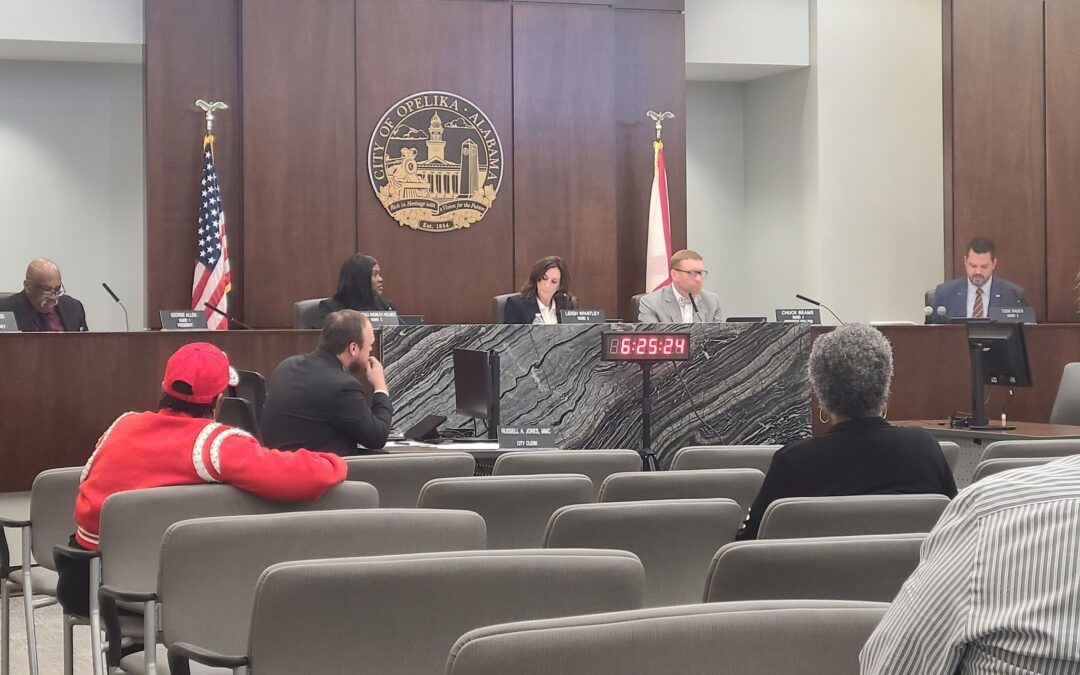
OPELIKA — The Opelika City Council voted Feb. 17 to deny a request for a package store license for Top Shelf Alternatives LLC at 510 Geneva St., citing zoning restrictions within the city’s Gateway Corridor overlay.
The denial stems from changes to Alabama’s hemp and CBD regulations enacted under House Bill 445 last year. The law, which took effect Jan. 1, places consumable hemp products under the authority of the Alabama Alcoholic Beverage Control Board.
During a work session prior to the meeting, City Planning Commission Director Matt Mosley explained the zoning conflict.
“Tonight you have a resolution before you dealing with the denial of a package store alcohol license at 510 Geneva St.,” Mosley said.
Mosley said any alcohol-related license must comply with the city’s zoning ordinance. The Geneva Street property is located in a Gateway Corridor zone, where package stores have not been permitted since 2010.
“It’s my understanding that there are a couple of different ways that a CBD hemp store can operate under the ABC,” Mosley said. “One is that they can sell only a very few limited products that are CBD and hemp-related. The other is that it can be licensed under a package store and sell liquor and CBD and other products allowed under a package store.”
However, allowing a package store at the location would require a zoning amendment.
“To make it an allowed use, we would have to go through an amendment of the text of the zoning ordinance, with a recommendation from the Planning Commission to the City Council,” Mosley said.
He added that approving one location would likely require allowing package stores throughout Gateway Corridors citywide.
“There really isn’t a way to approve one without approving the ability to seek them in the entire Gateway Corridor,” Mosley said. “If you make a change, it will likely lead to the proliferation of package stores throughout the city.”
Top Shelf Alternatives owner Bradley Haddon told council members the state’s regulatory changes left his business with limited options.
“Under the new rules, we must either operate as a standalone hemp retailer, which would require eliminating much, if not most, of our inventory, or obtain a retail liquor license,” Haddon said.
He said to continue selling existing products, the business must obtain both a package store license and a consumable hemp retailer license.
“One is a prerequisite for the other,” he said.
Haddon said operating solely as a hemp retailer would significantly limit the store’s offerings and leave thousands of dollars in inventory unsellable.
“We have close to $30,000 in inventory that we took off the shelves in January that we’re just sitting on,” he said.
He emphasized that the request is about compliance, not expansion.
“This is not about extending alcohol sales,” Haddon said. “This is about allowing an existing Opelika small business to comply with new state law and reopen legally.”
Haddon said the business closed Jan. 1 to comply with state law and has remained closed since.
“Being closed since Jan. 1 means 48 days without revenue at an average of $1,500 a day,” he said. “That is approximately $72,000 in lost gross revenue, not including rent, payroll, insurance and utilities.”
He said the business has invested approximately $22,000 in renovations to meet compliance requirements and continues to pay employees during the closure.
“We are not asking to operate outside the law,” Haddon said. “We are trying to comply fully.”
Haddon said the company has already worked with the ABC Board and completed required paperwork.
“We’ve already sat down with ABC,” he said. “The only thing left is for it to go through the municipality sign-off and back to ABC.”
When asked whether the business would meet all other ABC requirements if zoning were resolved, Haddon said yes.
Haddon urged council members to consider a path forward.
Ward 5 Council Member Todd Rauch acknowledged the complexity of the situation.
“A lot of what we do, there seems to be people caught in the middle,” Rauch said. “Knowing this is an existing business and that the state legislature has created new laws that shake things up, is there room for a special recommendation?”
Mosley said the city’s ordinance does not allow use variances and that courts tend to look unfavorably on such exceptions.
“Typically, our ordinance does not allow what we call use variances — where you allow a use in a specific zone where it is not currently allowed,” Mosley said.
Haddon said uncertainty at both the state and local levels has left him without clear direction.
“I still have not gotten any closer to reopening my store than we were six or eight weeks ago because nobody can tell me anything,” he said. “Every time I come to a City Council meeting, it’s another two weeks before I get any more answers.”
He said part of the delay stems from the absence of a municipal licensing category that matches the new state THC hemp license.
“There’s not a statute for me to turn my license into the revenue department because there’s not a category for it yet,” Haddon said. “You can get a business license. You can get an alcohol license. But there’s not one for the THC hemp license.”
When asked whether relocating outside the Gateway Corridor was an option, Haddon said the business has more than two years remaining on its lease at $3,250 per month.
“That’s about $80,000 to get out of,” he said. “We’ve already invested heavily into remodeling this location. I don’t know if we have enough to start over somewhere else.”
Haddon said when factoring in lost revenue, payroll, rent, insurance and renovation costs, the financial impact since Jan. 1 could approach $200,000.
“We’re just trying to follow the letter of the law,” he said. “We’re ready to go. The only thing left is to get this licensing process finished.”
Haddon said the business is seeking compliance, not special treatment.
“I’m not asking for special privileges,” he said. “If the state is mandating that we do this, then there needs to be a way for us to comply.”
Haddon said the continued delays have taken both a financial and emotional toll.
“No matter which way we turn, it’s slowly bleeding money out,” he said. “It’s like a death by a thousand cuts.”
At times becoming emotional, Haddon told council members the business represents everything he and his wife have invested.
“This is everything I own,” he said. “I put everything into this. This is all we have.”
