BY KADIE TAYLOR
THE OBSERVER
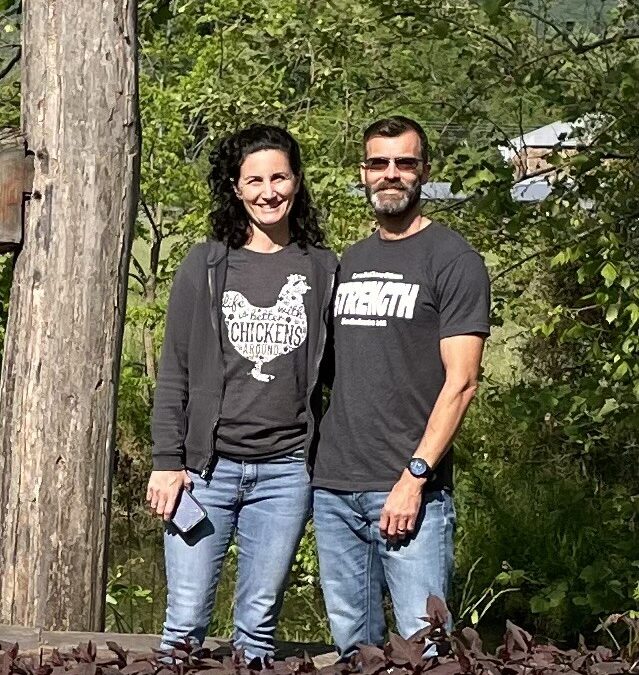
LEE COUNTY — Hard Work Farms is on a mission to provide healthier food options. With the growth of their farm,owners Ray and Erin Knight are now delivering sustainable and regenerative products like pasture-raised meats and farm products to people in Auburn and Opelika.
“We have so much available to you, whether it’s pasture chicken, pasture eggs, raw milk or even animal feed — we run a small animal feed business, as well,” said Ray.
“We’ve got an e-commerce website up and running,” said Erin. “It provides the convenience of how we’re used to shopping. We’re used to shopping online now, and it provides the convenience of placing an order and then either going to a pick-up location or possibly getting it delivered, depending on where you’re located. So it just seems like the next logical place to kind of go is the Auburn-Opelika area.”
Ray explained how the website, www.hardworkfarms.com, works.
“You click on [products], add them to your cart, check out and [choose] your delivery point,” he said. “Basically, once you do that, you check out and you’re good, and you’ll be able to get your product either the next pickup, or if you don’t need it that week, you can select it the following week.”
Although most pickup locations are in Alexander City, where the farm is located, customers can also pick up in Auburn and Birmingham.
Hard Work Farms offers soy-free pasture eggs by the half-dozen, dozen and 18-pack. It offers grass fed raw milk and soy-free pastured poultry — whole chickens, thighs, drumsticks, party wings, boneless tenderloins and breasts and whole turkeys.
With the holiday season approaching, Erin said locals can reserve a turkey now and serve them alongside locally grown produce.
“We are offering Thanksgiving turkeys,” she said. “So those can be pre-ordered on the website. If you pre-order, you can get the size that you would like. So, if you wanted like a 12-pound turkey, we need to know that so we know when to process the turkey. But if you were looking for a larger one, it just tells us how long they need to grow.”
Through selling their products to neighbors and cities nearby, Erin said she hopes to improve consumer education around where food in the grocery store comes from and the benefits of locally farmed food.
“I think consumer education is a big thing,” she said. “There’s a lot of confusion with all the labeling at the store. You know, is it ‘pasture-raised’ or ‘organic’? What does it all mean? Consumer education really happens when we can talk face to face with people, at farmers markets and fall festivals and that type of thing, that we can begin to expand what they know and where to research.”
Erin said the food grown at Hard Work Farms impacts the body differently, in a more positive way.
“Anytime you have food that’s grown regeneratively, it increases vitamin absorbency, antioxidants, beneficial omega threes and all the good stuff that you want to get out of your food — all that’s increased, and all the bad stuff is decreased,” she said. “Your gut is your biggest part of your immune system, and when you’re feeding it the right stuff, your body doesn’t fight itself.”
Additionally, Erin said the transparency at Hard Work Farms allows customers to see exactly where their food is coming from.
“Transparency for where your food is produced is really important,” she said. “You can’t walk into a meat factory — you know, Tyson, any of those places — you can’t just walk in. But if you wanted to come here and watch processing or see the birds, you could do it.”
Hard Work Farms’ story began in 2013, when one of the Knights’ children was diagnosed with food allergies.
“Never did we imagine starting a farm,” the Knights explain on their website. “In an effort to eliminate [allergins] from her diet, we began scrutinizing ingredient lists. While looking for the long list of synonyms for these products in our food, we questioned the other unknown ingredients. The questioning lead to reading, and reading to researching, and researching to action. It was clear we needed to get rid of these food-like products. It wasn’t a full pantry overhaul at once though, it was one product at a time.
“In 2016, we were given a few laying hens. This is where the slope became very slippery for us. A few hens led to moving to a larger property, [and] those few hens turned to 10. Since we were already in the chicken world, we decided to try to raise some for meat. In November of 2018, we ate the first full meal grown exclusively on our property. We were all-in,” they explained.
Soon after, permaculture and regenerative farming emerged as the Wrights’ main topics of conversation.
“It was logical and smart and made sense — it is our Creator’s design!” they said. “In a few short years, our little homestead in South Florida included chickens, turkeys, pigs, a vegetable garden and a tropical fruit forest. We also began selling eggs and meat to friends and found ourselves often sold out. Finding a larger property became a desire, and we expanded our search out of the state of Florida. Now in Alabama, we are taking what we learned on our small plot of land and applying it to larger acreage. We are using livestock to build the soil. Healthy soil produces nutrient-dense plants and animals. Nutrient-dense animals and animal products help maintain well-functioning human bodies. What we put in our bodies matters. Not only can we taste the difference, our bodies feel the difference.”
The Wrights said their growing process enhances nutritional value and flavor.
“When compared to conventionally-raised livestock, pastured meats are proven to contain a healthier fat profile, including higher levels of healthy omega-3 fatty acids and lower unhealthy saturated fats,” reads the website. “They are also rich in essential nutrients like CLA, vitamins like A, D and E and antioxidants. Food is medicine, not to mention its superior taste and texture.
“Humane farming practices align with sustainable agriculture and offer the most resilience in our changing climate, thus supporting a more eco-friendly food system. When properly managed, pastured animals create healthier soils and greatly reduce water and air pollution, compared to factory farming methods.”
Hard Work Farms is looking forward to expanding even more in the future.
“We’ve been here for a year,” Ray said. “We currently have pigs, chickens, turkeys and cattle. We have plans to continue expanding into getting sheep one day. We also continue to not only farm, but also process a lot of our stuff at our small farm. We really enjoy processing, so we plan to also create our own butcher shop here, as well.”
For more information or to order products, visit www.hardworkfarms.com.
