
BY GATOR KINCAID
FOR THE OBSERVER
AUBURN UNIVERSITY — Long considered one of college football’s greatest traditions, Auburn’s War Eagle flight was on full display this week ahead of the Tigers’ home game at Jordan-Hare Stadium.
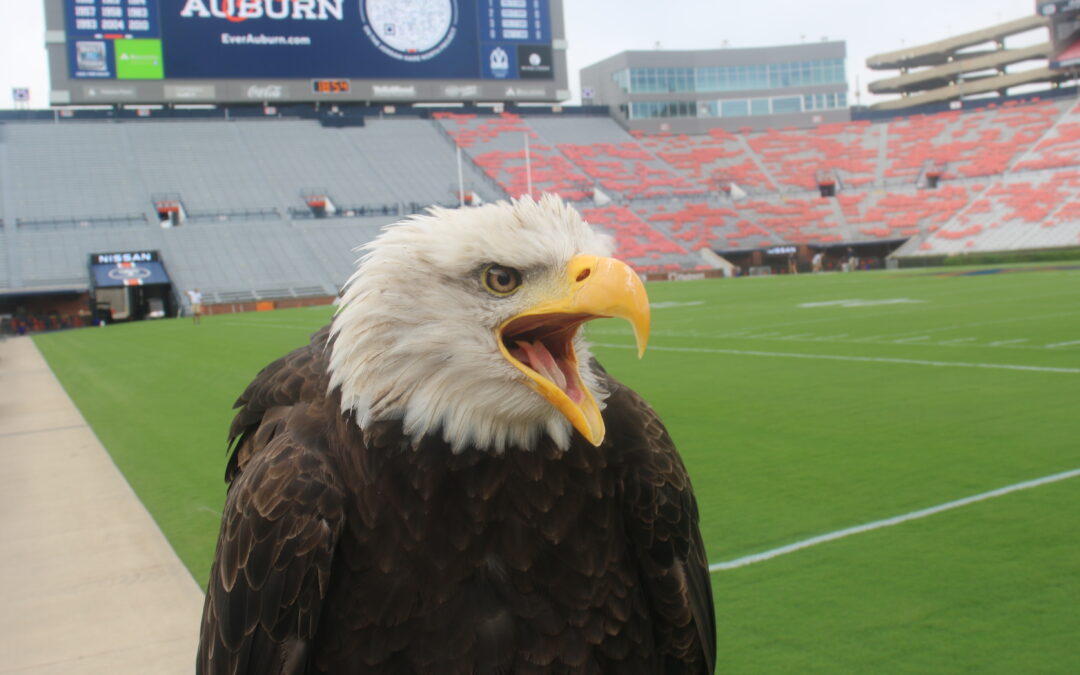
On Thursday, Sept. 10, the Auburn University Raptor Center invited media organizations to a special Media Day featuring Independence, a bald eagle and one of the center’s raptor ambassadors.
Known as “Indy,” Independence is one of the birds that helps bring Auburn’s spirit to life in front of nearly 90,000 fans on fall Saturdays.
The event gave reporters an opportunity to learn more about the preparation, training and care required to safely carry out the pregame flight.
“We consider them professional athletes, just like our football players,” said Andrea McCravy, a Raptor Center specialist. “They also require that repetition so they are ready for game day.”
The Raptor Center team — including McCravy, Assistant Director of Raptor Training and Education Katie Pnewski, Assistant Director of Raptor Rehabilitation Stephanie Kablitz, Assistant Director of Raptor Training and Education Amanda Sweeney and Director Dr. Robyn Miller — works throughout the year to prepare Auburn’s eagles for the stadium flight.
Preparing for game day
Training typically begins in early June, when the eagles return to the stadium for regular practice flights.
“We bring them to the stadium and fly them four to five days a week,” Pnewski said. “If it’s really hot, we might just do one flight, but we want to do multiple flights a day to build their muscles and endurance.”
The training also prepares the birds for changing weather conditions, particularly wind — one of the few elements the team cannot control on game day.
“We want to make sure our birds are confident flying in the wind and in different weather conditions,” Pnewski said.
Independence joined the Raptor Center in 2016 and began flying at games in 2021. Pnewski described her as a “workhorse” who enjoys the routine.
“She loves to work,” Pnewski said. “She has historically just really let the wind take her, so we fly her in different wind conditions to make sure she builds confidence and the skills to fight the wind.”
Independence’s flights have become a favorite part of the pregame experience for Auburn fans.
“Every Auburn fan gets ready for that flight,” Pnewski said. “That’s their favorite part before the game starts.”
Building trust
For Sweeney, preparing Independence for game day is a full-time commitment. Sweeney was the eagle’s first trainer and has worked with her throughout her development.
“It is all about trust,” Sweeney said. “We want the birds’ welfare to be the priority. A lot of the training is building that relationship.”
The team uses positive reinforcement and carefully observes the birds’ behavior to ensure they are comfortable and ready to fly.
Sweeney said she has learned to recognize even the smallest changes in Independence’s body language.
“If she fluffs up, sometimes that could mean she’s comfortable, cleaning her feathers or preening,” Sweeney said. “When she flattens all of her feathers and starts looking around, that’s when I’m worried. What is she looking at? Is she concerned?”
Independence is also known for being vocal around people.
“She is very talkative and excited to be around people,” Sweeney said. “When she’s not talking, I start wondering if there’s something else that has her focused.”
During the flight, Sweeney’s attention remains fixed on Independence.
“We practice five days a week, so game day is really just one big practice — a practice with 87,000 people watching us,” she said. “My concern is always making sure that she’s comfortable.”
Sweeney monitors Independence as she flies over the crowd and field, while also positioning herself to meet the eagle at midfield.
“A lot of that is trying to get to the 50-yard line before she beats me,” Sweeney said.
Caring for the birds
The health of Auburn’s eagles is another top priority at the Raptor Center.
Kablitz said many of the birds brought to the rehabilitation side of the center are injured, orphaned or ill. Each bird receives a physical examination and diagnostic testing to determine the appropriate treatment.
Some birds eventually become part of the center’s educational or flight programs because their injuries prevent them from being released back into the wild.
Kablitz said Arya, another eagle associated with the Raptor Center, was determined to be nonreleasable because of an injury. Once a bird enters the program, the staff continues to monitor its overall health and physical fitness.
“We make sure that they’re healthy and able to perform the tasks we’re looking for,” Kablitz said. “Flying in the stadium is one of those tasks.”
A tradition built over time
Miller said the center’s work is focused on both the birds’ welfare and the people responsible for carrying out the flight.
“I’m mostly here to support my team and my people so they can make this magical tradition occur,” Miller said. “As director, I want to ensure that our birds are set up with the highest welfare possible, but also the people who make the flight happen.”
Training an eagle can take years. The process begins with short, controlled exercises designed to build trust. The birds learn to step onto the trainers’ gloves, complete short flights in the amphitheater and eventually fly across the field while attached to a tether.
Once the birds consistently remain focused and respond to their trainers, the tether is removed. The eagles then progress from flights in the bleachers to flights from the center’s designated release points.
“There’s something magical and powerful about the first time you release a wild animal to fly without anything attached to it and trust them to return to you,” Miller said.
The goal is for the birds to return voluntarily — not because they are forced to, but because they associate their trainers with safety and positive reinforcement.
“We want them to come to us because it’s a positive thing,” Miller said. “They choose to return to us time and time again, like many of us choose to return to Auburn for football and community time and time again.”
For Auburn fans, that trust is visible in one of college football’s most recognizable traditions: an eagle soaring over Jordan-Hare Stadium before kickoff.
