
BY DANIEL SCHMIDT
THE OBSERVER
AUBURN — Before Bentlee Williams was old enough to walk, her body had already survived more than most people face in a lifetime. She had stomach surgery at two days old, complete kidney failure at a week and open-heart surgery at three months.
Before she was even born, doctors weren’t even sure she would survive at all.
“When I was pregnant with her, they actually weren’t even sure if she was going to survive outside of the womb,” said her mother, Cameran Williams.
Bentlee came through all of it. Now 15, she has competed in gymnastics since she was 3 years old and has twice won at the highest level Special Olympics offers in the sport. It was around that age, when she got her first glasses, that her family learned of another challenge: she has no depth perception.
One eye turns inward without correction, and anything moving toward her is hard to track. She could hit a ball off a tee, where the distance never changes, but tracking a moving object was another matter. Toss her a piece of clothing to put away, and she would bring her hands together only to watch it slip through.
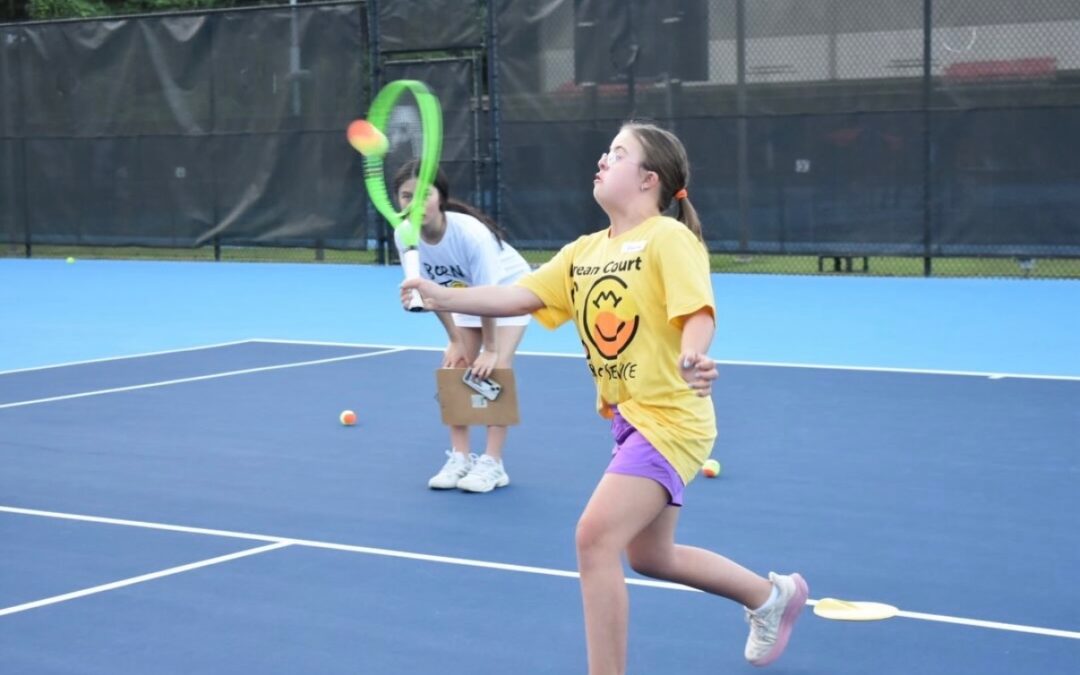
Which is what makes the sight of Bentlee tracking a tennis ball across the net and sending it back a small miracle layered on a larger one.
Williams, a former volleyball player, found tennis about four years ago and joined women’s league play at Auburn’s Yarbrough Tennis Center. Bentlee wanted in too, but she couldn’t reliably make contact because regulation tennis balls moved too fast for her to time.
Then, Williams heard about Dream Court, the adaptive tennis program that runs clinics at those same courts.
The difference came down to equipment. Dream Court uses a two-toned, lower-compression ball, which is easier to see against the court and slower off the bounce, giving Bentlee the extra beat she needs.
“The way that they adapt and use a two-toned colored ball made a huge difference for her,” Williams said. “She was able to see the ball a lot better.”
What it unlocked went beyond a single stroke. Last year Bentlee played in her first tournament and won. The skill of tracking something moving toward her has even spilled into daily life. These days, when Cameran tosses her that piece of clothing, Bentlee catches it.
It also gave the mother and daughter duo a sport that now belongs to both of them.
“It’s not hers. It’s not mine. It’s something we get to do together,” Williams said. “I love that she goes with confidence. She shows up and knows exactly where she’s supposed to be, and sometimes tells people where they need to be.”
A prayer answered
Jessica Weyreuter, the program’s founder and executive director, was a professional tennis player before she was a coach. After graduate school at Auburn University at Montgomery, the job offers she was chasing didn’t come, and a friend was left paraplegic in a skiing accident. She said it was one of the lowest points of her life.
“I asked God if he could guide me,” Weyreuter said. “It was very clear to me that I needed to start a tennis program for children and adults with disabilities.”
She launched Dream Court in Montgomery in 2013, where the city donated land for two courts. What began with five athletes has grown to serve more than 500 children and adults over the past decade, expanding into Huntsville, Daphne, Auburn and, most recently, Mobile.
Auburn’s chapter began with a teenager willing to make the drive. Auburn High School student and tennis player Jisung Choo kept traveling the hour-plus to Montgomery to volunteer and started wondering why Auburn couldn’t have the same thing.
He and his younger sister, Victoria, then pitched a local chapter. Weyreuter admitted she was hesitant to hand a satellite to a couple high schoolers, but the family had earned her trust, and the first Auburn clinic was held in the fall of 2023.
When Jisung left for college, he handed the program to Victoria, now 16 and the local coordinator.
She reserves courts, recruits athletes, communicates with parents and runs the clinics, all while taking International Baccalaureate and Advanced Placement classes and playing varsity tennis, where she went 22-2 and reached the Class 7A state final as a junior for the Lady Tigers.
“I think what I’m most proud of is how Dream Court has grown into more than just a tennis clinic. It’s really become a community and almost a family,” Victoria said. “It’s amazing to see athletes, parents, volunteers and coach buddies come back season after season and recognize each other, build friendships and genuinely look forward to seeing one another. There’s a really special bond that’s developed between everyone involved.”
How it works
There’s a common assumption that adaptive tennis needs a special court. It doesn’t. What matters, especially for wheelchair players, is access.
The adapting happens in the equipment. Different court sizes, rackets, lower-compression balls and the coaching, which borrows the five skill levels used by Special Olympics and matches the ball to the player. Participant ages have ranged from 5 to 90.
That flexibility is what Williams pointed to when other parents hesitate.
“Give it a chance, because the program is so wonderful at adapting to each kid’s needs,” Williams said. “They make each court appropriate for what skill level each student brings.”
What makes it work is a simple ratio: one “coach buddy” for each athlete, all clinic long.
Retiree Starr Miller, a pickleball player who volunteered for four days at Auburn’s summer camp after her friend and former Montgomery volunteer Jewel Pitt passed away a year ago, called it “beyond a doubt, a life-changing experience.”
“It was such a joy to see the look on their faces and the pure happiness when we were working with each other,” Miller said. “To be part of it and to get to know these athletes, they give as much back to me as I’m able to give to them. I don’t know any other way to say it. It’s just tremendous.”
Growing
Dream Court’s calendar now includes camps, unified doubles leagues and tournaments. For any athlete who wants to compete, the program covers entry fees, lodging, transportation and meals for up to three tournaments a year, and was the reason Bentlee walked off the court last year with a win.
“The athletes love the competition, and it’s been amazing to see their growth through it,” Weyreuter said.
Three years in, Auburn has become a proving ground: the first satellite to hold its own fundraiser, and this year the first to host a Christmas party outside Montgomery.
The immediate aim is more athletes on the courts, and Weyreuter’s request was simple.
“I would like the community to be open to learning that people with disabilities have huge potential. They really can learn to play tennis if they have the opportunity,” Weyreuter said.
For Williams, the proof is a daughter who spent the first months of her life in surgery now having a game she can call her own.
“I don’t think that would have been possible if Dream Court hadn’t come and shown me she was able to do it,” Williams said. “She just needed these specific accommodations to be successful.”
Volunteers and athletes can register at dreamcourt.org under the Programming tab, then Auburn. Because clinics and travel are free to athletes, the program is also seeking individual sponsors and local businesses to expand programming and opportunities.
