
CONTRIBUTED BY AUBURN UNIVERSITY
AUBURN — The Department of Theatre & Dance cordially invites the community to visit Fleet Street, London, circa 1820, where a barber is seeking sweet revenge and a pie shop owner is keeping a deliciously sinister secret.
Locals won’t need a time machine to visit — only a ticket for “Sweeney Todd: The Demon Barber of Fleet Street.” Lighting Designer Danielle Curtis and Costume Designer Jennifer Salter, both new faculty at Auburn, will make the rest of the experience real.
“The goal is to make certain that we’re telling a compelling story that people enjoy and want to come see again, but we also don’t want to be noticed at the same time,” Curtis said. “We really are there to make the actors become the people in the story and showcase the story. The written word that they give us — that’s the most important part of the whole production.”
“Sweeney Todd” is a darkly comedic musical thriller set in 18th-century London. Curtis’ research on its setting within the Industrial Revolution informed choices such as the hazy light seeping through the stage decorations and the greenish-blue pollution melting into vibrant red-orange sunsets.
A window unit at the back of the stage, which is also a projection surface, shows the interplay of colors and creates dramatic cues with images such as blood spatter across glass.
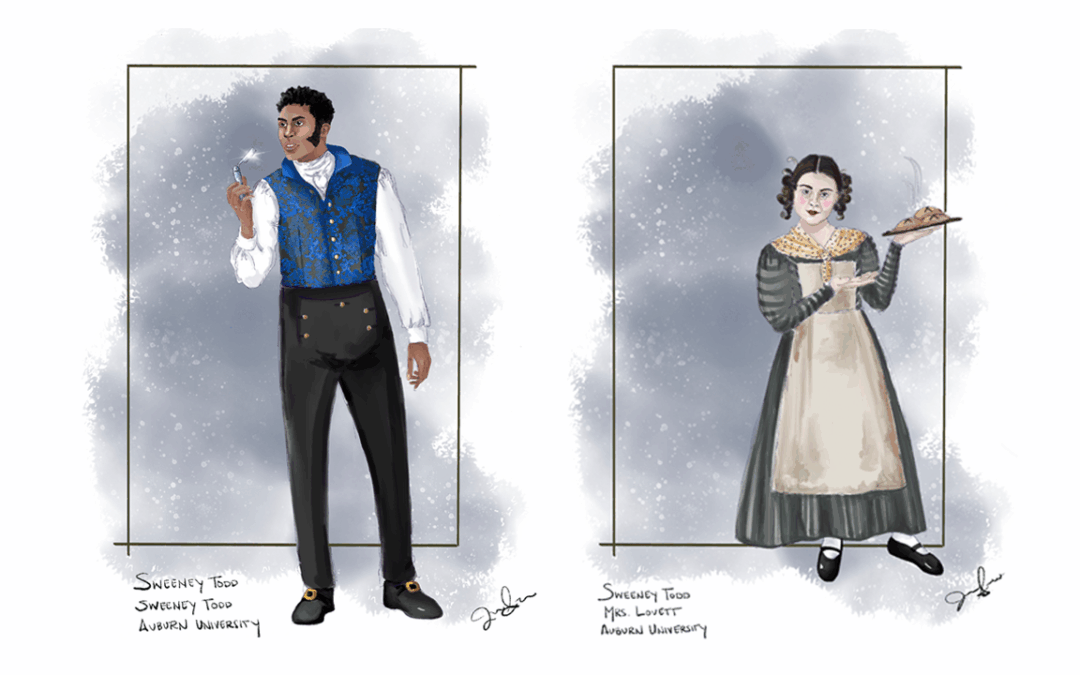
At the same time, Salter is telling a story with color and texture on fabric. The way clothes represent history has always been a passion for her, and improvements in lighting technology allow her to include more details in her costume designs.
One of her research specialties is textile history. For “Sweeney Todd,” she said she balanced historical accuracy with creative expression to bring the story to life.
“In Sweeney Todd, the story is the hero. It’s a period piece, but it’s not a play about costumes. It’s really easy for period pieces to become about costumes if you’re not careful,” Salter said. “So, for this show in particular, I wanted it to feel lived-in and real and have a lot of layers and textures and saturation because we have a lot of that surrounding us at all times. That lets the audience get themselves absorbed into the story, and what people are wearing is telling that story subconsciously.”
Characters will be dressed in costumes inspired by the early Victorian era, which was when the play was originally published as a penny dreadful. The costumes feature soft silhouettes which contrast against the harsh background and muddy, sickly colors that reflect the grimy atmosphere of Fleet Street.
Salter collaborates with Curtis on how costumes appear under the lights, and they both must consider the actors. Salter may change a dress design so an actress doesn’t trip on stairs, and Curtis may adjust haze so that actors don’t have trouble breathing.
Between them, the director, faculty, staff and dozens of talented students, the production works to entrance audiences from the opening number.
“Sweeney Todd: The Demon Barber of Fleet Street” will run from Feb. 19-28 at the Telfair B. Peet Mainstage Theatre.
Learn more about the show at the College of Liberal Arts website and buy tickets at the box office website.
About Auburn University
Auburn University is a nationally ranked land grant institution recognized for its commitment to world-class scholarship, interdisciplinary research with an elite, top-tier Carnegie R1 classification, life-changing outreach with Carnegie’s Community Engagement designation and an undergraduate education experience second to none. Auburn is home to more than 30,000 students, and its faculty and research partners collaborate to develop and deliver meaningful scholarship, science and technology-based advancements that meet pressing regional, national and global needs. Auburn’s commitment to active student engagement, professional success and public/private partnership drives a growing reputation for outreach and extension that delivers broad economic, health and societal impact.
