
Moratorium would pause certain new residential approvals and more
BY MICHELLE KEY
AND KADIE TAYLOR
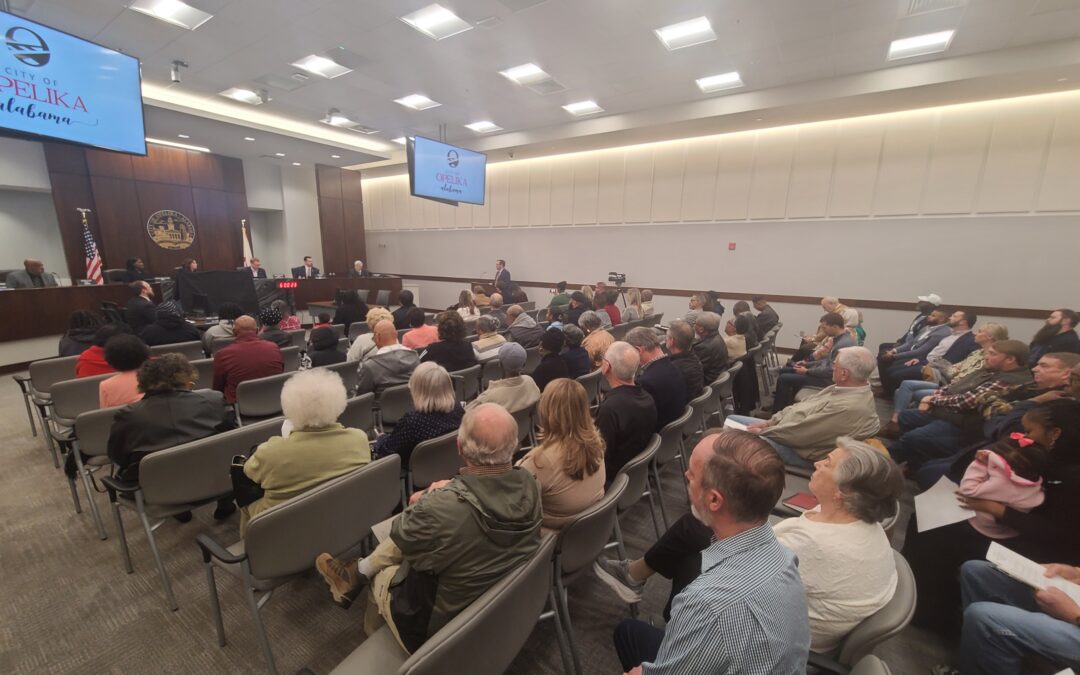
OPELIKA — The Opelika City Council announced last week that it is considering a proposed one-year planning moratorium, a measure intended to evaluate the city’s rapid residential growth and ensure infrastructure can adequately support continued development. The proposal dominated discussion during Tuesday night’s council meeting and the preceding work session, drawing extensive public comment both in favor of and against the temporary pause.
City leaders emphasized the moratorium is a proactive planning tool, not a halt to construction, designed to give staff and elected officials time to assess transportation networks, sewer and utility capacity, school impacts, public safety services and zoning regulations amid sustained residential expansion.
Purpose of the moratorium
During the work session held prior to the meeting, Opelika Planning Director Matt Mosley outlined the intent and scope of the proposed ordinance.
“The ordinance that is before you is laid out as a moratorium. Some people think of that as a building moratorium. What this does is it is more of an entitlement moratorium,” Mosley said.
Mosley acknowledged the city’s growth over recent years and said it has largely been a positive trend.
“So if you’ve been in Opelika for any time, you’ve seen the tremendous growth that we’ve seen and experienced, and I think that is a positive,” he said.
He said that growth, however, requires periodic review to ensure the city’s infrastructure and services are keeping pace.
“As we’ve grown, we’ve reviewed making sure that all of our utilities, infrastructure, transportation networks, schools — all of those items — are meeting the goals and needs of the City of Opelika,” Mosley said. “At times, we have to take steps to review those and make sure that items like sewer and transportation are where we need to make improvements or build for current or future development.”
Mosley explained that the moratorium would provide time for ongoing studies and regulatory work to take place.
“And so the moratorium basically does that. It provides the opportunity for some ongoing projects, ongoing studies and regulatory work to take place during the moratorium that would allow us to review and update regulations,” he said.
He added that the pause would also allow the city to step back and evaluate broader planning issues.
“It would also provide some time to look at the bigger-picture issues — look at our zoning ordinance and look at multiple other factors that would play into the growth and development of the city,” Mosley said.
What the moratorium does — and does not do
Mosley was careful to clarify that the proposed ordinance would not halt development already underway.
“What this moratorium does not do is it does not stop overall development and construction in Opelika,” he said.
Instead, he said, the pause would apply to new entitlements, such as rezonings, new planned unit developments and certain conditional uses that have not yet been approved.
“It simply looks at items like rezonings, like master development plans through a planned unit development where someone goes in and shares a master development plan and then gets entitled for a certain amount of development,” Mosley said. “It also looks at conditional uses for residential or mixed-use that have not been acquired previously.”
Projects already approved would not be affected, Mosley said.
“So those items, like an apartment complex or things like that, it doesn’t stop those projects where people have worked and invested and gone through the steps before the Planning Commission and before the City Council to get entitlement and approval on those projects,” he said. “We’re not stopping someone midway through the development of a project.”
The goal, he said, is to pause the approval of new residential entitlements while the city evaluates its regulations and capacity
“But what it does is it pauses entitlement and approval of potential new projects so that we’re not continually adding to the number of units that are possible without giving you some opportunity to study where we’re at, what regulations we need to address, and make amendments to before we move forward,” Mosley said.
Growth statistics and timeline
City officials said Opelika has experienced sustained residential growth in recent years. In 2025 alone, more than 2,000 new residential units were entitled. Currently, more than 6,500 residential lots and more than 2,500 townhouses, multifamily or mixed-use units have already been approved or are in various stages of planning or construction.
If approved, the moratorium would take effect May 1, 2026, and remain in place through April 30, 2027.
During that period, the Planning Commission, in coordination with city staff and other departments, would be directed to conduct detailed studies, engage the public and bring recommendations back to the City Council before the moratorium expires.
City leaders stressed the pause is temporary and targeted, designed to support orderly, sustainable growth while protecting the health, safety and quality of life of residents.
Public support for the moratorium
Several residents spoke in favor of the proposed moratorium during public comment, citing concerns about infrastructure strain, traffic congestion and preserving Opelika’s small-town character.
Rachel White, a Piedmont Avenue resident, thanked the council for considering the proposal.
“Thank you for taking the pause, the reflection, time and effort and energy to consider this motion,” she said. “It is a big deal, and just the fact that you are considering it is incredibly refreshing.”
White said she supports at least a one-year moratorium and pointed to growth statistics she believes warrant a pause.
“I’d like to say I’m in favor of at least a one-year moratorium,” she said. “For the last week, I’ve thought about what I wanted to say, running through all the numbers — how we’ve had 4% growth in Opelika year over year, how we have roughly 6,500 single-family units in the pipeline for construction, 2,500 more multifamily. That’s 9,000 lots for a town of 35,000.”
She said those figures raise questions about the city’s ability to keep pace.
“I thought about what it would do to our infrastructure, how we could potentially almost double our school population, add probably over 10,000 vehicles to our road system, and then the amount of actual people that we would need to serve in our infrastructure — both water, fire safety, police officers,” she said.
White said she ultimately focused less on numbers and more on what drew her family to Opelika.
“I just paused for a moment, and I thought, you know what, more than all of those numbers is I love this small town. I love it,” she said.
She referenced national recognition Opelika has received and urged council members to protect that identity.
“And let’s not turn one of America’s best small towns into a mediocre, midsize one,” White said.
Her husband, Drew White, also spoke in support of the moratorium, saying it reflects responsible leadership.
“I just want to commend the mayor and city council for considering this,” he said. “I think it is a testament to a responsible way of thinking about how we want our city to grow and what we want our city to look like.”
Drew White referenced the couple’s experience living in Georgetown, Texas, where he said growth was poorly managed.
“We were in a place called Georgetown, Texas, which is just north of Austin,” he said. “When we lived there, it was about 55,000 people. When we moved back to Opelika in 2021, that number was up to almost 80,000, and today there’s almost 112,000 people there.”
He said city leaders there approved development without adequate planning.
“They rubber-stamped everything. They didn’t really think through it. They just wanted growth for growth’s sake,” White said.
He said the result has been increased crime and diminished community engagement.
“Church attendance is down. Crime is up 35% just in the last five years in Georgetown,” he said.
Drew White encouraged Opelika leaders to learn from that example.
“I think a one-year minimum is probably the minimum,” he said. “At the very least, this is responsible.”
Jeff Reichel, a Town Lake Parkway resident, said the moratorium would allow the city time to reassess its development framework.
“The question before the council tonight is, considering the significant growth of the past decade, is it time to step back, slow things down and re-evaluate the permitting process?” Reichel said.
He said a pause would allow time to address gaps in development policy and protect residents.
“A framework is needed for these residents to halt such conditions,” he said. “So please vote for at least a one-year moratorium.”
Amanda Guilmette, a Fox Run Village resident and local hairstylist, also spoke in favor of the proposal.
“I am in favor of this, and I thank you guys for even taking it on,” she said.
Guilmette said her work puts her in daily contact with residents across demographics and has given her insight into infrastructure challenges.
“I work with a variety of different people my age, older retirees and what I am seeing is that we do not have the infrastructure to support this amount of growth,” she said.
She shared a recent personal experience she said highlights strain on health care services.
“I was recently bitten by a dog, and I have not been able to receive wound care at EAMC or get the care that I need, because it’s overrun by people,” Guilmette said.
She also raised concerns about traffic and development in her neighborhood.
“It takes me 10 to 15 minutes to get out of my neighborhood in the morning to go to work,” she said.
Guilmette said the moratorium would allow the city time to evaluate infrastructure needs more thoroughly.
“I think that a pause would give us all time for you guys to audit the hard and soft infrastructure to make sure that our community stays a well-run community,” she said.
Concerns about unintended consequences
Not all speakers supported the proposed moratorium.
Race Cannon, a local developer, cautioned that a residential pause could have unintended consequences.
“I’m not sure of the wisdom of doing it. That’s in your hands,” Cannon said. “One is unintended consequences of a residential moratorium that might scare off business.”
Cannon said a project he is involved in near U.S. 280 and Veterans Parkway could be affected.
“If this moratorium passes, the only route that I could have to getting apartments approved right there would be conditional use,” he said.
He said the timeline required under the ordinance could make that approval difficult.
“I don’t know that that can be done in two months,” Cannon said.
He said he provided council members with alternative language that would allow certain projects with privately installed infrastructure to proceed.
“What this text would do is identify projects that carry installed infrastructure privately, and it would allow any residential project that meets that test to move forward,” Cannon said.
Next steps
The ordinance was introduced for its first reading and the City Council is expected to vote on the issue during the Feb. 16 council meeting.
If adopted, city officials say the pause would be used to gather data, engage the public and bring forward potential updates to zoning and development regulations before the moratorium expires.
